Question-Based Learning
Students' questions guide the learning journey, not the teacher's answers.
What is it?
Question-Based Learning puts the question at the center of the educational process. Instead of the teacher presenting answers nobody asked for, conditions are created for students to formulate genuine questions that motivate inquiry and knowledge construction.
The quality of questions matters more than the quantity of answers. Students learn to distinguish closed from open questions, surface questions from deep ones, questions answered by Google from questions that require thinking.
The teacher models the art of questioning: uses Socratic questions, scales complexity, and teaches students to convert spontaneous curiosity into investigable questions. Over time, students internalize this skill.
The ability to ask good questions is more important than the ability to give good answers.
— Dan RothsteinWhat does it look like in class?
The teacher shows an intriguing image and asks students to generate all the questions that arise. Students then classify the questions into groups and choose the most interesting ones to investigate.
Using the QFT (Question Formulation Technique), students generate questions from a stimulus, classify them as open or closed, prioritize them, and plan how to answer them.
The teacher never answers a question directly that the student can investigate. Instead, responds with: Where could you look that up? What do you already know that helps? How could you verify it?
Students keep a 'question journal' where they record questions that arise in each topic. At the end of the unit, they review which ones they could answer and which remain open.
Signs it works
- Students generate more questions than answers during a class
- Questions become deeper and more specific over time
- Students question information sources and don't accept the first answer
- Phrases like 'What if...?' 'Why not...?' 'How do we know...?' are heard in class
- Students correct each other and look for evidence before making claims
Common mistakes
Asking closed questions disguised as inquiry — if there is only one possible answer, it is not a genuine question
Not giving time to formulate questions — thinking good questions requires silence and reflection
Rewarding only correct answers without valuing good questions
Derailing the process by answering everything quickly instead of guiding the search
Key thinkers
Co-creator of the Question Formulation Technique (QFT) and co-founder of the Right Question Institute. His method transforms students' relationship with questions.
Co-creator of the QFT with Rothstein. Researches how the ability to ask questions empowers marginalized communities.
Author of A More Beautiful Question. Explores how the best questions lead to innovation and deep learning.
Dive deeper
The Right Question Institute book on the QFT. Step-by-step guide to teaching students to formulate their own questions.
WebsiteRight Question InstituteFree resources, videos, and guides to implement the QFT in the classroom. Some materials available in Spanish.
ESWebsiteThe Question as a Tool — Educación 3.0Article in Spanish on how to use questions to guide learning with practical examples.
VideoQFT Technique ExplainedExplanatory video of the Question Formulation Technique with classroom examples.
 ToolQuestion Dice
 ToolKWL Organizer
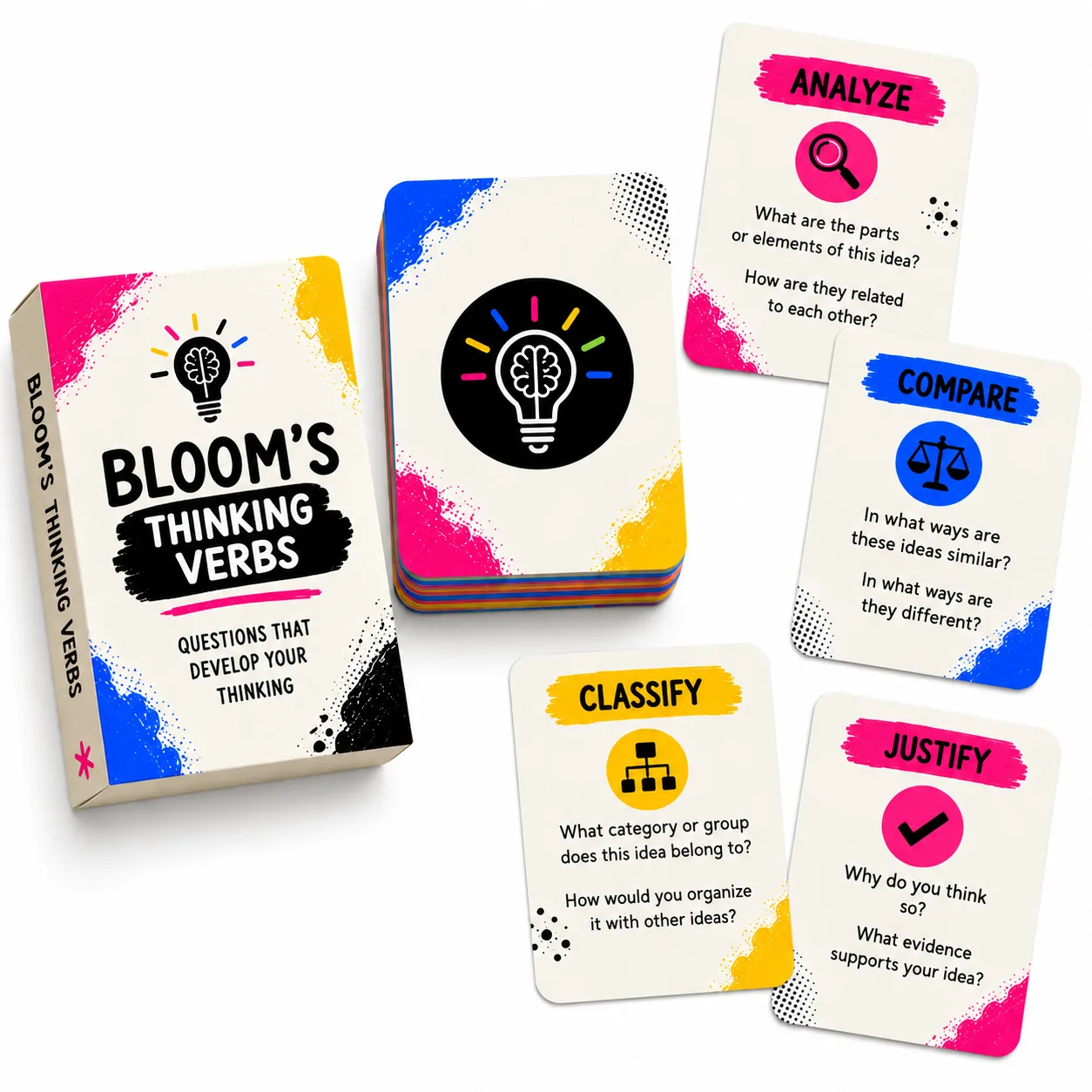 ToolBloom Cards
 ToolSilent Debate