The problem with learning styles theory
The learning styles theory — the idea that each person learns better through a preferred channel (visual, auditory, kinesthetic, etc.) — is one of the most widespread beliefs in education. It is also one of the most refuted by research.
In 2008, Pashler, McDaniel, Rohrer and Bjork published a comprehensive review of the evidence in Psychological Science in the Public Interest and concluded that, despite the popularity of the concept, there is no robust evidence that adapting the teaching method to the student’s preferred learning style produces better results. Other meta-analyses (Rogowsky et al., 2015; Newton & Miah, 2017) reached the same conclusion.
This does not mean that students do not have preferences — they do. It means those preferences do not reliably predict how they learn best. The student who says “I am a visual learner” does not necessarily learn better with images than with text.
Why does understanding this matter? Because the popular version of learning styles leads to pedagogical decisions that can limit learning rather than amplify it: labeling students as “visual” or “kinesthetic,” designing classes that only use each student’s “channel,” and never challenging them to develop less comfortable forms of learning.
What does exist: real diversity in the classroom
The fact that VAK theory (visual-auditory-kinesthetic) lacks empirical support does not mean all students learn the same way. There are real and documented differences that teachers must attend to:
The factor that most predicts ease in learning new content is what the student already knows about that topic. Two students in the same class can have radically different backgrounds, making the same text trivial for one and incomprehensible for the other.
Not all students process new information at the same rate. This does not reflect intelligence — it reflects differences in fluency with certain types of tasks, which is related to the level of practice and the automation of basic processes.
Engagement with content varies enormously according to the connection the student makes between the topic and their own interests or experiences. A student who finds a topic irrelevant to their life processes the information with less depth, regardless of how it is presented.
Students differ in how developed their tools are for studying, remembering, organizing information and monitoring their understanding. These differences are modifiable with explicit instruction.
What really works: multiple means of representation
Instead of adapting teaching to the student’s style, Universal Design for Learning (UDL) — a framework developed by the Center for Applied Special Technology — proposes a different principle: offering multiple means of representation, action and expression so that more students can access content from their different starting points.
The principle is not “teach each person in the way they prefer.” It is “do not present content in only one way, because no single format is optimal for everyone.”
This means:
- Presenting the same concept in text, image, audio and concrete example (not because some are “visual” and others “auditory,” but because redundancy of representations facilitates everyone’s comprehension)
- Offering multiple ways to demonstrate learning (not only the written exam)
- Providing multiple means of engagement (choice, relevance, variety of formats)
The choice board as practical differentiation
The choice board is a direct differentiation tool that does not require labeling students. The teacher designs between 4 and 9 options to demonstrate the same learning in different formats: writing an explanatory text, creating an infographic, recording a short video, designing a diagram, preparing an oral presentation, building a physical model.
Everyone works with the same content and the same learning objective. The difference is in the production format. This respects students’ real preferences without classifying or limiting them. And paradoxically, when choosing their format, students tend to produce with more quality and commitment than when the format is imposed.
A more sophisticated variant is the 3x3 choice board (inspired by tic-tac-toe): students choose three activities in a straight line, combining options from different difficulty levels or different types of thinking.
Learning stations as simultaneous multiple representations
Learning stations are a direct implementation of the multiple representations principle: the classroom is organized into 4 or 5 stations where the same content is worked on in different formats. At one station a text is read; at another an image or map is analyzed; at another a concrete problem is solved; at another a discussion happens in pairs.
All students go through all stations, which guarantees exposure to multiple formats. This is pedagogically more solid than the “VAK style” version where each student only goes to “their” station.
The learning stations organizer allows planning the rotation, time at each station and instructions for each group without the teacher having to manage everything manually during the class.
Prior knowledge: the variable that matters most
If there is one variable the teacher should diagnose before teaching new content, it is prior knowledge. John Hattie’s research (2009), in his analysis of more than 800 meta-analyses, identifies prior knowledge as one of the most powerful predictors of academic performance.
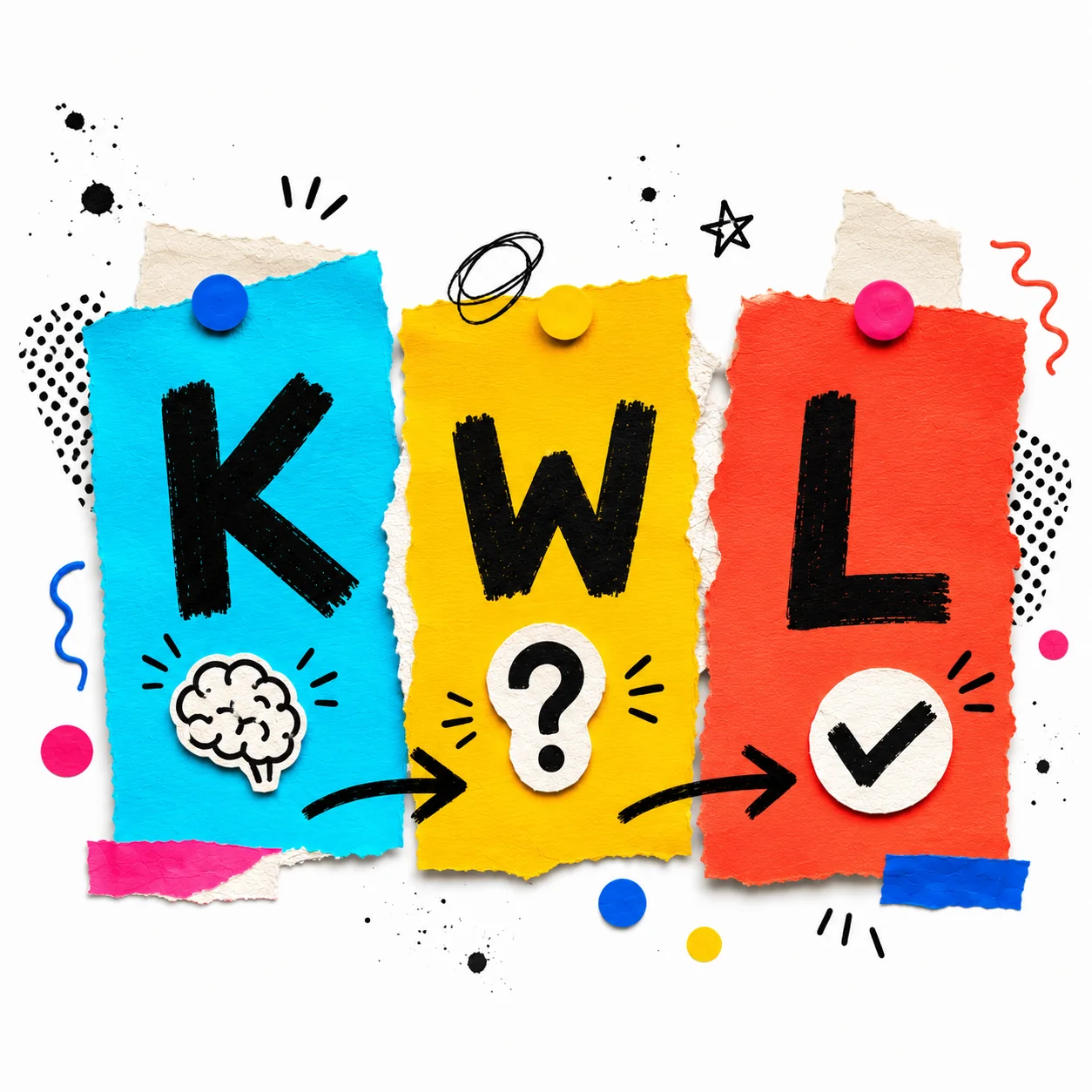
The KWL chart (What I Know / What I Want to Know / What I Learned) is a simple tool for activating and making visible that prior knowledge at the start of a unit. In 10 minutes the teacher has a map of the group’s starting point that allows adjusting the entry level of the explanation.
A useful variant: ask students to post on the collaborative ideas wall a sentence summarizing what they already know about the topic. The diversity of responses reveals precisely the range of prior knowledge in the group — and that range is usually broader than the teacher assumes.
Learning strategies: the difference that can be taught
While style preferences do not predict learning, learning strategies do — and they are teachable. Dunlosky and colleagues’ research (2013) on study techniques identifies the strategies with the greatest proven impact:
Retrieval practice: attempting to recall information without looking at notes, rather than re-reading them. It is the strategy with the greatest impact on long-term retention. Tools like bingo and crosswords implement this strategy in disguised form.
Spaced practice: distributing study time instead of concentrating it (“cramming the night before the exam”). Forgetting between sessions is part of the process — the effort to remember what was forgotten consolidates learning.
Elaboration: connecting new content to what is already known, by asking “why does this make sense?”, “how does this relate to X?” Elaboration produces deeper understanding than repetition.
Teaching these strategies explicitly — not only using them but explaining why they work — produces significant improvements in performance, especially in students who do not know them.
How to differentiate without labeling
The trap of learning styles is not only that the theory is weak — it is that labeling a student as “kinesthetic” or “auditory” can become a limitation. Students tend to act according to the categories assigned to them. A student who believes they only learn “hands-on” may resist reading complex texts — and miss out on learning that only those texts can provide.
The alternative is to differentiate by need and starting point, not by style:
- Differentiate by level of prior knowledge: offer texts or problems of different complexity according to where each student is, not according to how they “like” to learn
- Differentiate by type of support: some students need more scaffolding (step-by-step instructions, example models, glossed vocabulary); others can work with more autonomy
- Differentiate by product: offer options in how to demonstrate learning, without limiting exposure to content
The choice board implements this type of differentiation without classifying or labeling — it simply offers options and lets the student choose.
Free tools for addressing real diversity
Choice board — for differentiation without labels
The choice board offers between 4 and 9 options to demonstrate the same learning in different formats: text, infographic, oral presentation, diagram, model. Everyone works with the same content and the same objectives. The difference is in the production format — without classifying or labeling anyone.
Learning stations organizer — for simultaneous multiple representations
The learning stations organizer allows designing 4 or 5 stations where the same content is worked in different formats: text at one station, image analysis at another, concrete problem at another. All students go through all stations, guaranteeing exposure to multiple formats without labeling anyone as “visual” or “kinesthetic.”
KWL chart — for diagnosing the starting point
The KWL chart (What I Know / What I Want to Know / What I Learned) activates and makes visible prior knowledge at the start of a unit. In 10 minutes the teacher has a map of the group’s starting point that allows adjusting the entry level of the explanation — the variable that most predicts ease in learning new content.
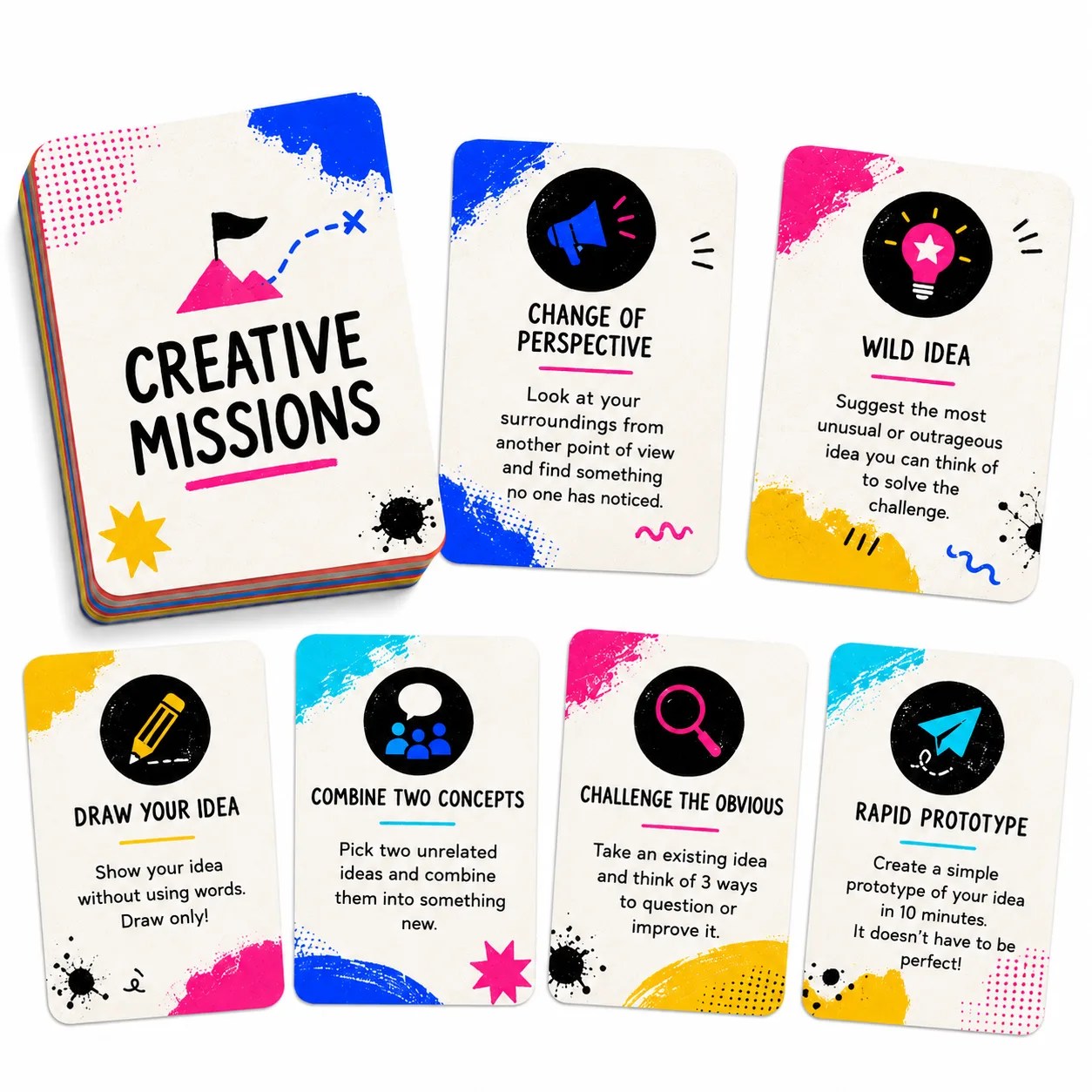
Creative mission cards — for different types of thinking
Creative mission cards propose challenges for approaching the same content from different angles. They allow different types of thinking (narrative, visual, analytical, practical) to find their place within the same activity, without a single format excluding anyone.
Collaborative ideas wall — for making the group’s diversity visible
The collaborative ideas wall gathers in a shared space what each student knows or thinks about a topic. The diversity of responses makes visible the range of prior knowledge — and that range is usually broader than the teacher assumes. Seeing that diversity helps calibrate the entry level.
I Used to Think, Now I Think — for making the learning process visible
The I Used to Think, Now I Think tool allows students to record their starting point and how their understanding changed. It makes the learning process visible beyond the final result — especially useful for showing students that they learned, even when they feel they “know nothing.”
Common mistakes
Classifying students and maintaining that classification. Preferences and capacities change. A student who has difficulty with reading in second grade can become an avid reader in fifth if they receive adequate support. Fixed labels tend to become self-fulfilling prophecies.
Reducing the learning diet to the preferred format. If a student says “I hate reading,” the pedagogical response is not to avoid texts — it is to work on reading from more accessible formats (shorter texts, with visual support, with clear purpose) and gradually increase the demand. Limited exposure produces limited skills.
Ignoring prior knowledge. Starting to teach without diagnosing the group’s starting point is equivalent to building on unknown foundations. The gap between what the teacher assumes students know and what they actually know is one of the most frequent causes of disengagement.
What competencies it develops
- When students learn to identify which study strategies work best for them and when to use them, they are developing learning to learn in its most concrete sense.
- When they monitor their own understanding during the process and adjust their strategies, they are practicing self-regulation of learning.
- When they face presentation formats that are not their preference and develop skills in those formats, they are building adaptability — cognitive flexibility.
- When they understand that difficulties are part of the process and that effort produces improvement, they are internalizing the growth mindset that sustains long-term learning.
How to start
Use the KWL chart at the start of the next unit. In 10 minutes the teacher has a diagnosis of the group's prior knowledge that allows adjusting the entry level of the explanation.
Design the next task with a choice board of 4 options: written text, visual presentation, oral presentation and diagram or concept map. Same content, different formats. Observe what each student chooses and what quality they produce in each format.
Introduce retrieval practice as a regular closing routine. A question of application, a vocabulary crossword or a concept bingo at the end of each class consolidates learning efficiently and in a more emotionally engaging way than re-reading the notebook.