Creative Summary Cards for the Classroom
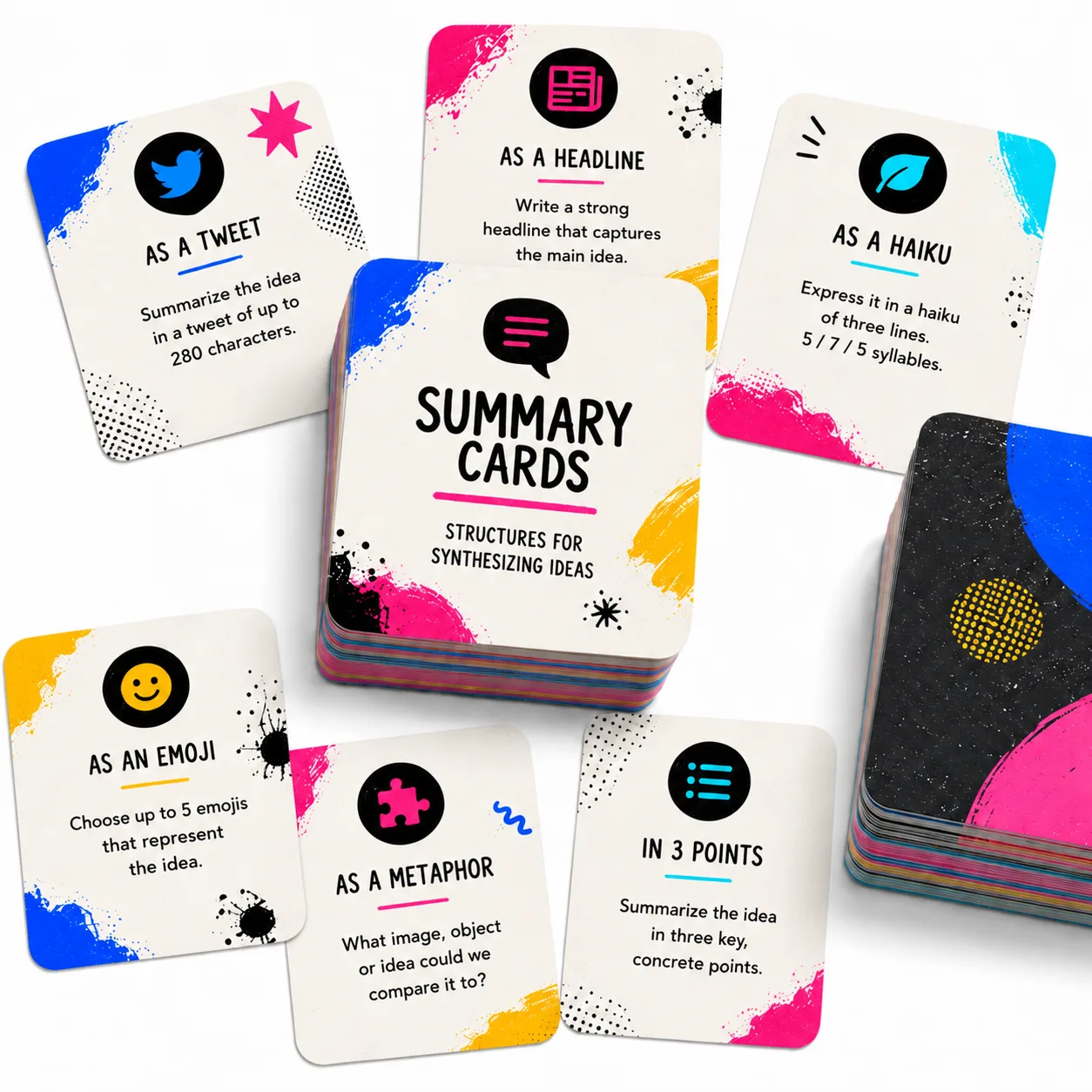
Summary Cards offer alternative formats for synthesizing content: instead of writing a conventional summary, students synthesize what they learned as a tweet, a newspaper headline, a haiku, a list of 3 essential points, or a sequence of emojis. Each format has different constraints that activate different synthesis skills, and comparing results from different students opens richer conversations than comparing conventional summaries.
Format constraints as a learning tool
A conventional summary allows including almost everything. A 280-character tweet does not. A 17-syllable haiku doesn’t allow explanation — it demands finding the image. A list of 3 points forces hierarchization. Those constraints are the central pedagogical tool of the deck: they force an active decision about what is most essential in the content, which is exactly the cognitive operation that differentiates surface-level from deep understanding. Forced brevity activates synthesis; synthesis activates understanding.
Synthesis as evidence of understanding
When two students synthesize the same text in a tweet and compare what they included, the difference reveals what they each considered most important and why. That conversation is evidence of understanding far richer than verifying whether an answer is correct: it shows how each person organizes knowledge, which aspects of the content they master and which they don’t. The teacher can use those differences to show that the same content has several valid cores.
Closing and exit activity
The deck works especially well in the last minutes of class: the teacher projects a card and everyone synthesizes what they learned in that format. 5 to 8 minutes total is enough. In its exit activity version, students write their synthesis on a piece of paper they hand in as they leave, giving the teacher a quick overview of group understanding without grading tests.
Frequently asked questions about Summary Cards
What summary formats does the deck include?
The deck includes formats of different types and levels of constraint. Formats with extension limits: tweet (maximum 280 characters), newspaper headline (maximum 12 words), single-sentence phrase, list of 3 essential points. Formats with fixed structure: haiku (three lines of 5, 7, and 5 syllables), equation (A + B = C to represent a relationship), before/after (what changed). Metaphorical formats: summarize as an emoji or sequence of emojis, compare the topic to an everyday object, choose a color that represents the content and explain why. Each format activates a different type of content processing.
Why is summarizing in creative formats more effective than traditional summaries?
Traditional summaries can be done mechanically: copying main ideas without genuinely processing them. Formats with strong constraints force an active decision: what is most essential? A 280-character tweet doesn't allow everything; it forces prioritization. A haiku doesn't allow explanation; it forces finding the most representative image. That constraint is what activates deep understanding. When two students synthesize the same content in a tweet and compare what they included, the difference reveals which aspect of the topic each considered central — opening a much richer conversation than comparing two conventional summaries.
When in the lesson is the summary deck best used?
The deck works best as a closing activity: after an explanation, a reading, a video, or a discussion, the teacher projects a card and asks everyone to synthesize what they just saw or heard. 5 minutes is enough for individual synthesis and another 5 for sharing some results. It also works as an exit activity: in the last 3 minutes of class, each student draws a card and everyone writes their summary on a piece of paper they hand in as they leave. Those papers are an immediate comprehension check that requires no correction time.
Can it be used to work on reading comprehension?
Yes, it is one of the most direct uses. After reading a text, the teacher draws a card and asks students to synthesize the text in the indicated format. If the headline format comes up, the challenge is to write the most precise possible headline for that text. If list of 3 comes up, the challenge is to identify the three ideas that cannot be omitted. If haiku comes up, the challenge is to capture the essence of the text in a poetic image. These exercises activate understanding in different ways: the headline works the main idea; the list of 3 works hierarchization; the haiku works metaphorical synthesis.
For which educational levels is it appropriate?
From primary through higher education, adjusting the complexity of format and content. In primary, the most accessible formats are the list of 3 points, a drawing that explains the topic, and a one-sentence phrase. The haiku can work if the format is already known. In secondary, all formats in the deck are appropriate. In higher education, the most demanding formats are especially useful for developing academic synthesis capacity: synthesizing a complex argument in a sentence or 280 characters is a communication skill directly applicable outside the classroom.
What if different students include different things in their summary?
Those differences are the most valuable moment of the activity. When the teacher asks 'why did you include that point and not another?', the answer reveals which aspects of the topic each student considered most important and why. Those conversations are evidence of understanding far richer than checking whether an answer is right or wrong. The teacher can use the differences to show that the same content has several valid cores depending on the angle from which it is viewed.
Can the same format be used multiple times with different content?
Yes, and there are advantages in doing so: students who already know the format can focus on the content instead of understanding the mechanics. Some teachers use the same format (for example, the list of 3) consistently throughout an entire unit, so students build the skill of prioritizing in that format. Others prefer to rotate formats to maintain novelty. Both strategies are valid: consistency deepens the skill; variety maintains interest.
What competencies does this activity develop?
Summary Cards primarily develop Metacognition (to synthesize well you need to know what you understand and what you don't), Creative thinking (finding the most efficient representation in a format with constraints), and Purposeful writing (each format has a different communicative function requiring different writing decisions). When comparing summaries with classmates it also activates Critical thinking and Active listening.
What pedagogies support using creative formats for summarizing?
The summary deck applies principles of Formative Assessment: the syntheses give the teacher real-time information about group understanding without formal tests. It is also grounded in retrieval practice research: actively synthesizing what was learned consolidates memory far better than re-reading it. In comparative variants, it applies principles of Cooperative Learning and Visible Thinking.