PBL is not doing a group presentation
Project-Based Learning (PBL) is probably the most cited and most poorly implemented pedagogical approach in contemporary education. When a teacher says “we’re going to do a project,” they could mean very different things: anything from a group research assignment with a PowerPoint presentation to a genuine process of solving real problems with community impact.
The difference is not superficial. Well-designed PBL has specific components that separate it from traditional group activities: an open and authentic driving question, a real final product directed at an audience beyond the teacher, an inquiry process where students discover knowledge rather than receive it, and systematic reflection on learning throughout the process.
The confusion between “project” and “group assignment with a grade” explains why many teachers try PBL, feel it did not work, and never try it again. The problem is rarely the approach — it is the design.
The research behind PBL
The evidence on PBL is solid when the approach is well implemented. John Larmer and John Mergendoller, from the Buck Institute for Education, systematized in 2015 the elements of “Gold Standard PBL” based on decades of research and practice in more than 3,000 schools. Their review identifies seven key design elements that distinguish effective PBL from cosmetic PBL.
Strobel and van Barneveld’s (2009) meta-analysis reviewed 8 comparative studies and found that PBL outperforms traditional instruction in long-term retention, transfer of knowledge to new contexts, and student and teacher satisfaction. Direct instruction outperforms PBL on standardized tests in the short term — an important data point that helps calibrate expectations.
The reason PBL produces more durable retention is well explained by situated cognition theory (Brown, Collins and Duguid, 1989): knowledge learned in authentic contexts, to solve real problems, becomes anchored to concrete situations that facilitate retrieval and transfer. Knowledge learned abstractly for an exam tends to be forgotten faster because it lacks those contextual anchors.
The 7 elements of a good project
The Buck Institute of Education identifies seven elements that must be present for a project to be genuinely PBL and not simply a group assignment with a presentation:
The project starts from an open question that does not have a single correct answer. The question must be authentic — it must matter outside the classroom.
Students search for, produce and evaluate information rather than receiving it passively. The process is iterative: they generate questions, investigate, arrive at new questions, investigate further.
The context, task or impact is real. Students create something that exists in the world: a campaign, a product, a proposal, an event, a service. They are not just simulating it.
Students have some degree of decision over the process, the product or both. This does not mean everything is open-ended — it means not everything is prescribed.
Students reflect on their learning process, not just the content. What went well? What would they change? What did they learn about how they learn?
The product goes through feedback and improvement cycles before its final version. This is incompatible with projects where the "first version" is the submission.
The final product has an audience beyond the teacher. This naturally raises the quality of work: students try harder when they know others will see what they produced.
How to design a project in 6 steps
Step 1: Define the driving question
The driving question is the heart of the project. A good driving question is open (it does not have a single correct answer), authentic (it matters outside the classroom), action-oriented (“How might we…?”, “What should…?”) and calibrated to the group’s level.
Weak questions: “What is climate change?” (has a factual answer) or “Why is it important to recycle?” (rhetorical, no tension).
Strong questions: “How might we convince the families in our community to reduce car use?” or “What would happen to our city if pollinators disappeared?”
Step 2: Define the final product and audience
What will students produce? For whom? The product can be a presentation, a video, a prototype, a campaign, a proposal, a manual, an exhibition. What matters is that it has a real audience: other students, families, outside experts, the community.
A real audience transforms the quality of work. When the only audience is the teacher, the work is for a grade. When there is a real audience with genuine interest in the product, the work is for something.
Step 3: Map the knowledge and skills needed
What do students need to know and be able to do to carry out the project? This map determines what direct instruction is necessary (because some knowledge is not discovered independently), what can be learned autonomously and what skills require guided practice.
This step is key to avoiding superficial PBL: the project does not replace instruction — it contextualizes it. Students need to learn rigorous conceptual content; the project is the framework that makes that learning authentic and applied.
Step 4: Design the phases and checkpoints
A well-designed project has clear phases with partial products: research (sources identified and analyzed), prototype or draft (first version of the product), feedback (from peers and teacher), final version, public presentation.
Each phase has a checkpoint where the teacher reviews progress and gives feedback before the team continues. Without these checkpoints, teams arrive at the due date with a finished product that can no longer be improved.
Step 5: Establish evaluation criteria from the start
The project rubric must be available to students from the first day. When students know exactly how their work will be evaluated before they begin, they can make better decisions throughout the process and self-assess their progress.
A rubric generated with the tool available on this site allows you to define criteria precisely and share them with the group from the project presentation.
Step 6: Plan for reflection
Reflection is not a bonus for when there is time left — it is a structural component of PBL. Plan at least three reflection moments: at the start (What do we know? What do we need to know?), during (How are we working as a team? What is working?), and at the close (What did we learn? What would we do differently?).
Free tools for managing the project
Kanban Board — for making work visible
The Kanban Board is the central management tool for PBL. The team organizes their tasks in three columns: to do, in progress, and done. Each task has a visible owner and a deadline. This resolves the most common problem in projects: the teacher not knowing how each team is progressing without asking each group individually. With the kanban projected, progress is visible to everyone at all times.
Priority Voting — for making democratic decisions
When the team must decide which research direction to pursue, what format to give the final product or what to do first, Priority Voting gives each member a voice. This prevents the most vocal member of the group from always making decisions and develops collective decision-making ability — a central competency in PBL.
Work Gallery — for a closing with a real audience
At the end of the project, the Work Gallery lets each team display their product and the rest of the class browse, observe and leave comments. It is a more dynamic alternative to the traditional oral presentation and meets the PBL requirement of having an audience beyond the teacher. Groups can also invite people from outside the classroom.
Group Generator — for building balanced teams
Project groups should be heterogeneous and assigned without favoritism. The Group Generator builds teams at random in seconds, eliminating negotiation and ensuring everyone has a team. It is especially useful when the teacher wants to break habitual groupings without it seeming like an arbitrary decision.
Role Cards — for distributing responsibilities
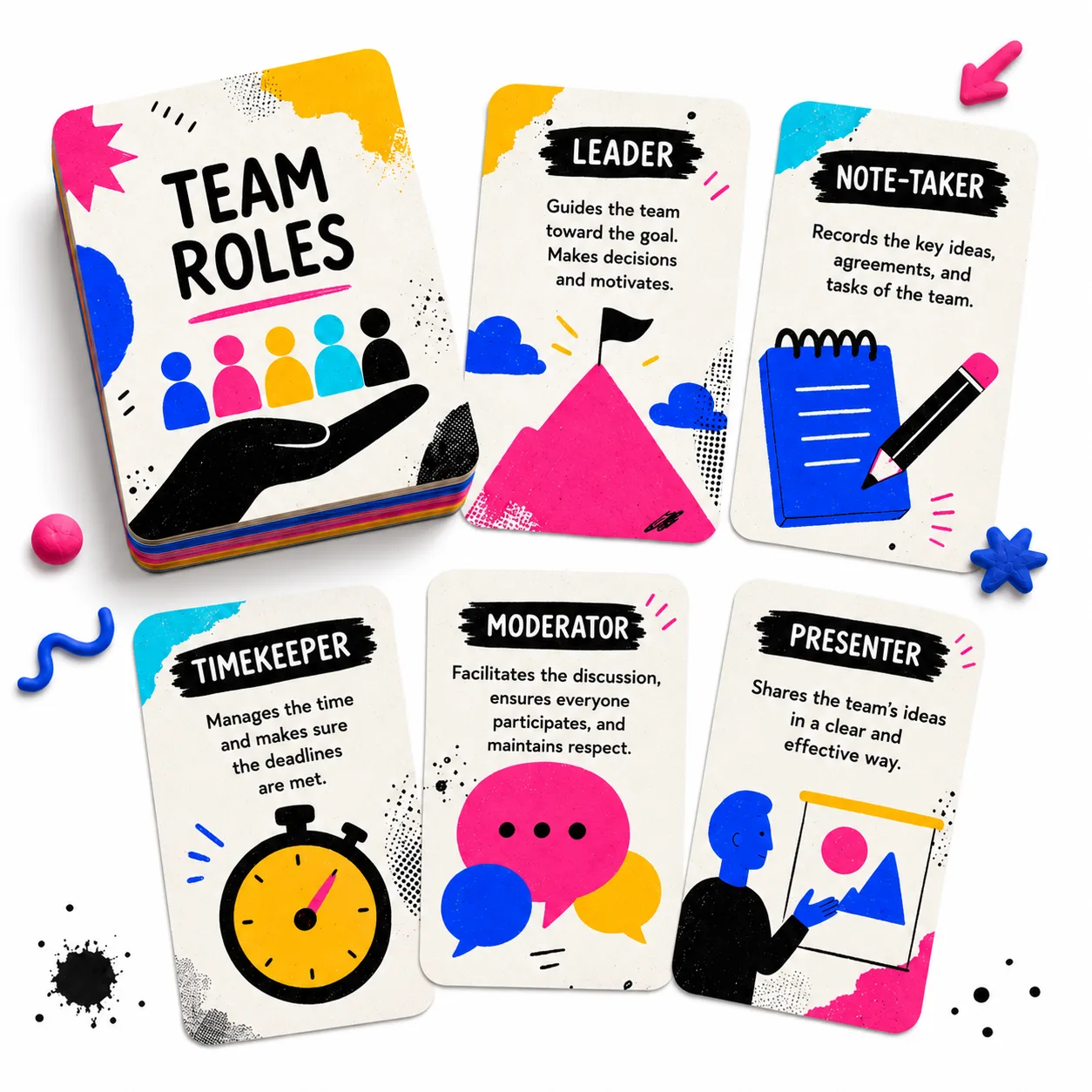
With roles explicitly assigned from the start of the project, each member knows exactly what they are responsible for. Role Cards describe the responsibilities of the coordinator, researcher, communicator and documenter. In multi-week projects, roles should rotate so that everyone develops all functions.
Rubric Generator — for evaluating with clear criteria
The project rubric must be available to students from the first day. The Rubric Generator allows you to define criteria precisely and share them with the group from the project presentation. When students know exactly how their work will be evaluated before they begin, they can make better decisions throughout the process and self-assess along the way.
The difference between cosmetic PBL and genuine PBL
| Cosmetic PBL | Genuine PBL | |
|---|---|---|
| Opening question | “Research X” | “How might we solve Y?” |
| Source of knowledge | Teacher transmits, group organizes | Students inquire with teacher guidance |
| Product | PowerPoint presentation for the teacher | Real artifact for an external audience |
| Evaluation | One grade at the end | Clear rubric from the start, iterative feedback |
| Reflection | Does not happen or is optional | Structured at multiple moments |
| Teacher’s role | Assigns and waits for the result | Designs, accompanies, gives feedback, adjusts |
Common mistakes
Starting with a project that is too large. First projects should last 2 to 3 weeks, not a full term. Short projects allow both the teacher and students to learn the mechanics of the format before facing the complexity of an extended project.
Not establishing checkpoints. Without intermediate reviews, teams can spend weeks going in the wrong direction. Required checkpoints — where the teacher reviews progress and can redirect — are what distinguishes PBL from pedagogical laissez-faire.
Evaluating only the final product. The learning process is at least as important as the product. Including process evidence (research notes, drafts, kanban records, written reflections) in the evaluation incentivizes genuine work rather than last-minute production.
Not teaching the necessary content. PBL does not replace direct instruction — it contextualizes it. If students need to understand photosynthesis to tackle a project on urban agriculture, photosynthesis must be taught. The project is the framework, not the only method.
What competencies it develops
Well-designed PBL is one of the most effective approaches for developing transversal competencies in authentic ways:
- When teams identify the problem, seek information, analyze options and design solutions, they are exercising problem-solving in real contexts, not simulated exercises.
- When they divide tasks, negotiate decisions and produce something none of them could do alone, they are developing collaboration in its most concrete sense.
- When they generate ideas for the product, experiment with formats and take creative risks, they are exercising creative thinking with real consequences.
- When they plan the project, set partial goals and track their progress, they are practicing goal planning with concrete tools.
How to start
The first project does not need to be perfect — it needs to be real. A recommended progression:
A 2-week "mini-project" with a simple question and a concrete product (a 2-minute video, a poster, a written proposal). The goal is for the group to learn the mechanics of the format, not to produce the best work of the year.
Use the kanban board from the start to make progress visible, and priority voting for team decisions. Establish one checkpoint midway through the process.
Design the driving question with students, invite an external audience for the final presentation and structure reflection with written questions at the close. The Work Gallery is a good format for that moment.
The key is to start with a small, well-designed project, learn from it and gradually increase complexity.