The problem with the frontal class
The teacher explains. Some students follow. Others got lost a while ago. Those who already understood are bored. Those who do not understand need more time. But the class moves at the same pace for everyone because the structure demands it: one teacher talking, thirty students listening (or not).
Learning stations break this structure. Instead of one activity for everyone at the same time, there are 4 to 6 simultaneous activities. Students rotate in small groups, each station lasts a defined amount of time and the teacher stops being the center of attention — becoming instead someone who circulates, observes and assists.
The concept is simple. The implementation, however, has pitfalls. When stations do not work, the classroom becomes chaos: noise, students lost, uneven timing and the feeling that “this is not for me.” When they work, the change is visible: everyone is working, each at their own pace, and the teacher has time to attend to those who need it most.
The theory behind the practice
Tomlinson (2001), the authority on differentiated instruction, proposes stations as one of the most effective strategies for addressing diversity in the classroom. The logic is simple: if students have different starting points, a single activity cannot serve them all. Stations allow different students to do different things without the teacher needing to be everywhere at once.
Kolb (1984) argued that effective learning requires passing through four modes: experiencing, reflecting, conceptualizing and applying. A single activity rarely covers all four. A circuit of stations can be designed so that each station activates a different mode: a reading station (conceptualizing), an experiment station (experiencing), a discussion station (reflecting), a production station (applying).
Marzano (2007) identified that physical movement and changing activity every 10 to 20 minutes significantly improve attention and retention. Stations incorporate both naturally: students move and the task changes.
Anatomy of a station that works
An effective station has five elements:
| Element | What it is | Why it matters |
|---|---|---|
| Clear task | Written instructions the student can follow without help | If they need to ask what to do, the station depends on the teacher |
| Prepared materials | Everything they need is at the station | If materials are missing, they lose time searching |
| Visible product | Something they produce (written, drawing, response, construction) | Without a product, there is no way to verify what they did |
| Defined time | Visual timer shared by everyone | Without visible time, some rush and others take forever |
| Autonomy | Can be completed without teacher intervention | If the teacher must be at every station, it does not work |
The golden rule: if a station needs the teacher to function, it is not a station — it is a directed activity with a fancy name.
Three progressive station designs
Design 1: Same content, different formats
All stations work the same content but in different ways: one with reading, one with video, one with manipulation, one with discussion. Each group rotates through all of them.
This design is the simplest to plan (one body of content) and works well as an introduction to the format. Example for natural sciences:
- Station 1: Read a short text about the water cycle
- Station 2: Observe a set-up experiment (evaporation)
- Station 3: Complete a diagram of the cycle
- Station 4: Discuss and answer “What would happen if evaporation did not exist?”
Design 2: Complementary stations (each contributes one piece)
Each station covers one part of the topic. Students rotate through all of them and at the end assemble the pieces into a synthesis. This design creates interdependence: they need to go through all the stations to have the complete picture.
Example for history:
- Station 1: Economic causes of the revolution
- Station 2: Political causes
- Station 3: Social causes
- Station 4: Immediate consequences
- Final synthesis: concept map integrating all four stations
Design 3: Stations by level (real differentiation)
Some stations are for reinforcement, others for extension. Students go to the one they need. This can be combined with a choice board: 2 required stations for everyone + 2 optional stations the student chooses based on their level or interest.
This design requires more planning but solves the central problem of heterogeneity: each student works in their zone of proximal development.
How to plan the circuit
Step 1: Define the learning objective
Stations are not an end in themselves — they are a means to a specific objective. Before thinking about activities, define: “By the end of this circuit, students should be able to…”
Step 2: Design the stations (4 to 6)
Each station needs: instructions written in clear language, prepared materials, expected product and estimated time. The Learning Stations Organizer lets you set up the entire circuit in one place: name, task, duration and materials for each station, with cards ready to print or project. A practical rule: if the instructions do not fit on half a page, they are too complex.
Step 3: Calculate timing
Total available time ÷ number of stations = time per station. Subtract 2 to 3 minutes for transitions between stations. If there are 80 minutes and 4 stations: 80 ÷ 4 = 20 min − 3 min transition = 17 minutes per station.
Step 4: Build the groups
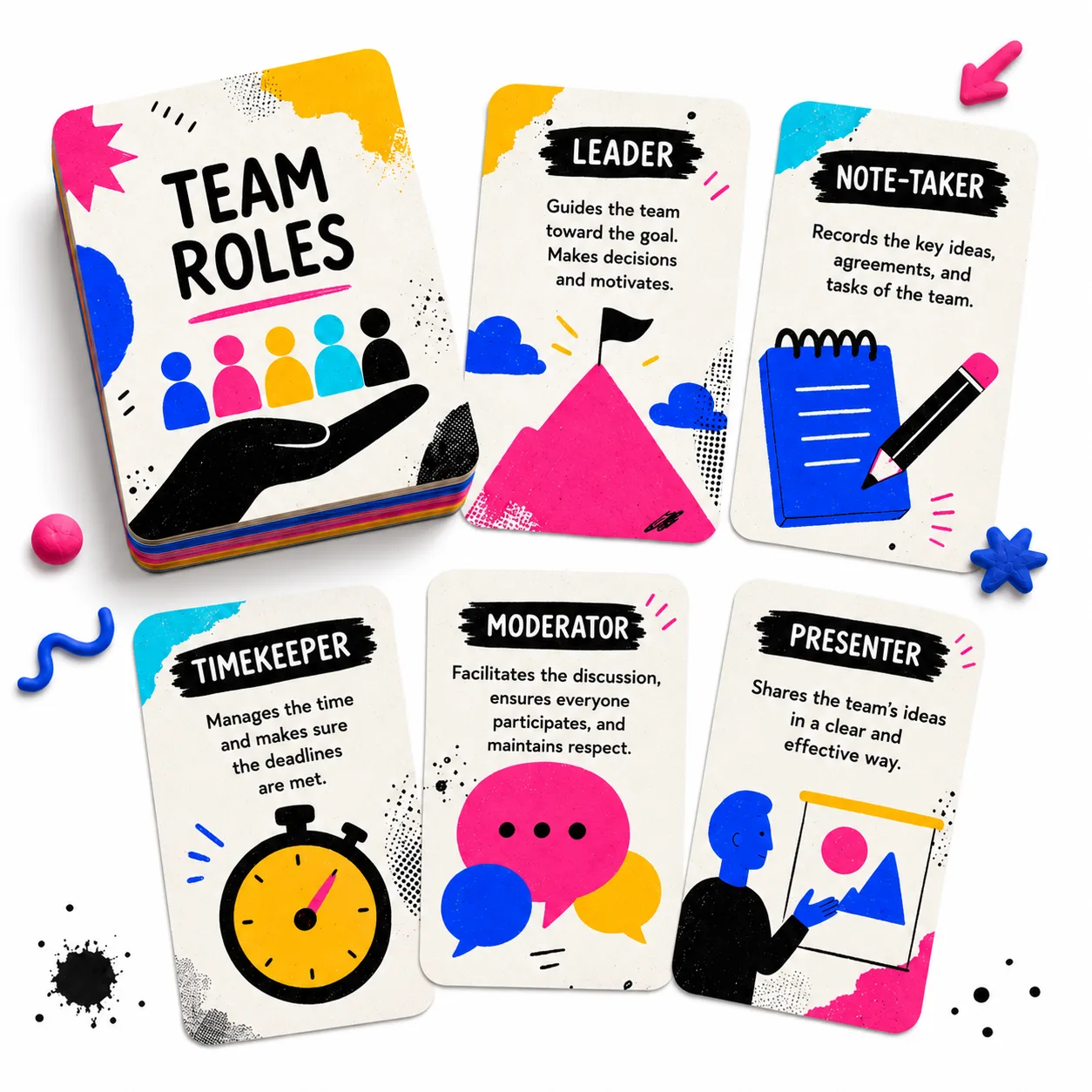
Use the Group Generator for teams of 3 to 4 students. Larger groups generate passivity; smaller ones limit discussion. Assign Role Cards within each group.
Step 5: Prepare the logistics
Number the stations. Prepare a chart with the rotation order. Configure the Visual Timer with an alarm for each rotation. Have a plan for students who finish early (bonus station or choice board).
Free tools for each phase
Visual Timer — the central regulator
The timer projected on screen is the heart of the system. Students see how much time they have left without asking, without depending on the teacher and without losing their sense of rhythm. When it sounds, they rotate. The predictability of time reduces anxiety and increases focus.
Role Cards — so no one watches from the sidelines
At each station, roles activate: the reader reads the instructions, the writer records, the timekeeper signals the time, the checker verifies the answer makes sense. Roles rotate with each station — so everyone practices all functions.
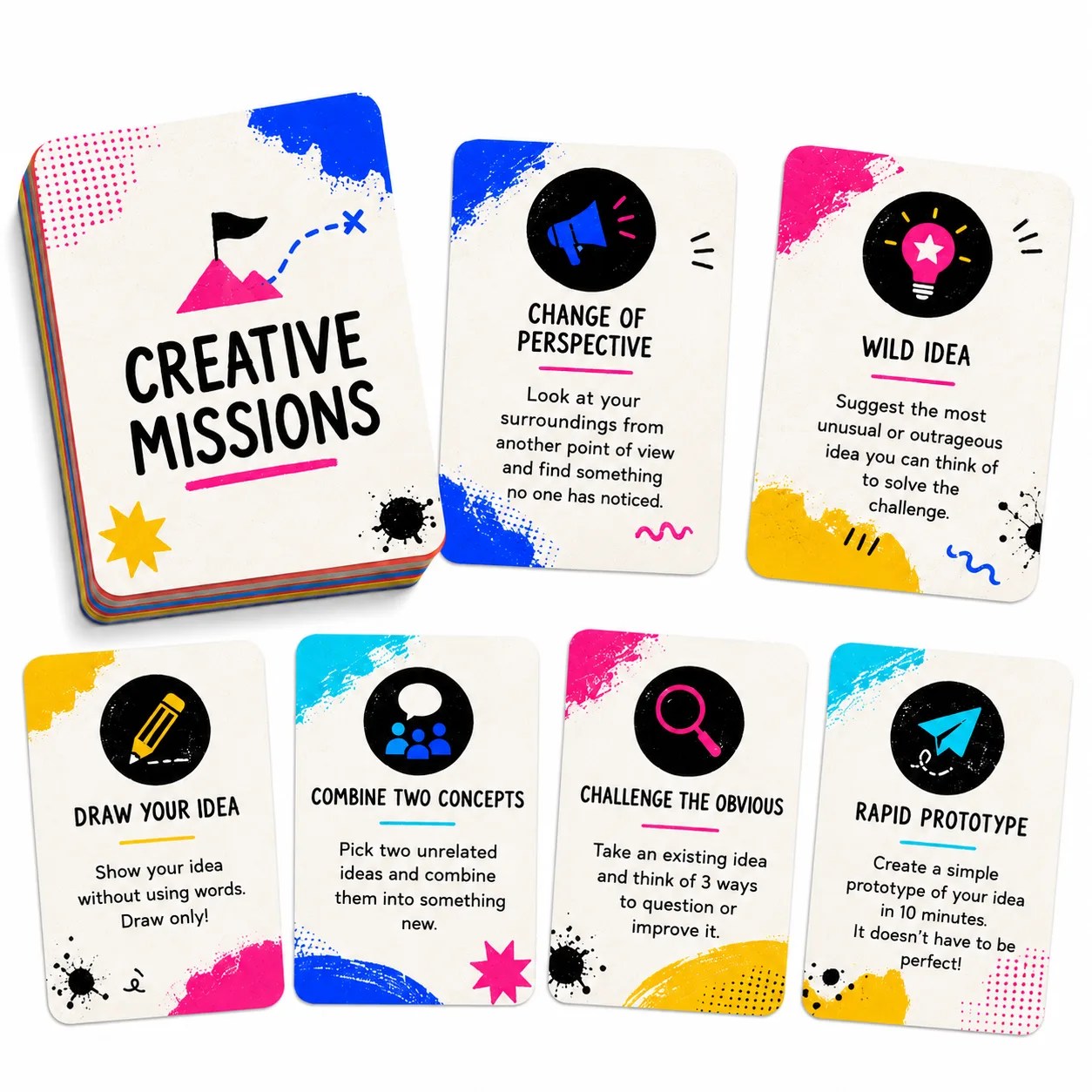
Creative Mission Cards — to turn tasks into challenges
Instead of “Read the text and answer the questions,” the mission says: “You are researchers who just discovered an ancient document. Read the text and extract the 3 most important clues to solve the mystery.” The content is the same; the excitement is different.
Comprehension Stoplight — to monitor without interrupting
While students work at stations, the teacher circulates. The stoplight lets them see at a glance which group needs help (red), which has doubts (yellow) and which is progressing well (green). They can prioritize their attention without interrupting those who are working.
Choice Board — for students who finish early
The classic problem: one group finishes in 10 minutes and another needs 20. The choice board offers optional stations for those who finish: “If you finished, choose one of these extension activities.” No one waits with nothing to do, no one gets bored.
Learning Stations Organizer — to design the complete circuit
The specific tool for this guide. Allows loading each station with its name, task, duration and required materials. Generates individual cards ready to print and place at each table, or to project on screen. Solves the most common planning problem: having all the information scattered in the teacher’s head instead of organized and visible for students.
Group Generator — for mixing without drama
At the start of each station session, the generator builds teams at random. This breaks fixed dynamics (“I always work with my friends”) and ensures that over the course of the month everyone has worked with everyone. The randomness eliminates negotiation and conflict over “I do not want to be with them.”
Common mistakes when setting up stations
Instructions that require verbal explanation. If the teacher must go station to station explaining what to do, they lose the main advantage of the format: autonomy. Instructions must be self-explanatory. A useful test: could a student who arrives late understand what to do by reading the instructions? If not, they need to be rewritten.
Too many stations or stations that are too long. Four stations of 15 minutes work better than seven of 8 minutes. Students need time to enter the task, produce something and close it out. Less than 10 minutes per station generates superficiality.
A station that depends on the teacher. If one of the stations is “teacher explanation,” the system collapses: groups pile up waiting their turn while the teacher is occupied with another. All stations must function without the teacher present.
No plan for uneven timing. Groups do not finish at the same time. Without an extension activity (choice board, bonus station, extension question), those who finish early generate noise and distract those who are still working.
Using stations once and abandoning them. The first time is always the most chaotic. Students do not know how to rotate, they lose time with logistics and the teacher feels “it did not work.” The second time is significantly better. The third time, it flows.
What competencies it develops
Stations do not only diversify instruction — they develop competencies:
- When a group manages their time to complete the station before the alarm, they are practicing time management in a real context.
- When a student who finished decides to go to the extension station instead of waiting, they are exercising initiative and proactivity.
- When the group organizes itself internally to fulfill roles and produce the expected result, they are practicing self-managed collaboration.
- When a student moves from a reading station to an experiment station and then to a discussion station, they are exercising adaptability — adjusting to different tasks and formats.
- When they monitor their own progress and decide to ask for help (red stoplight) or keep going, they are developing self-regulation.
How to start
Divide the class in two halves. One half reads a text and answers questions; the other does a practical activity. After 15 minutes, they rotate. Just two stations, one rotation. The goal is not the content — it is for students to learn the format.
Add two more stations, activate the visual timer and assign one role per group (minimum: timekeeper). Instructions must be written at each station. The teacher circulates but does not explain — observes and assists.
Add an optional station or a choice board for those who finish early. Add all roles. By this point, students already know the dynamic and the focus can be on the quality of the activities, not the logistics.
Stations do not work the first time they are implemented — they work the third time. The investment is in the first sessions; the return is a classroom where students work autonomously while the teacher does what they do best: teach the ones who need it most.