Why praise can do exactly the opposite of what is intended
In 1998, Claudia Mueller and Carol Dweck published one of the most replicated experiments in educational psychology. They took 400 fifth-grade students and subjected them to a reasoning test. After the first part, one group was told: “You must be very smart.” The other group was told: “You must have worked very hard.”
What followed was systematic and surprising. The group praised for their intelligence, when given the option to choose the next task, chose the easiest one — they preferred to protect their reputation as smart. The group praised for effort mostly chose the hardest. Faced with a second, more difficult problem, the first group interpreted the difficulty as a sign they were not as intelligent after all. The second group interpreted that they had not worked hard enough. Faced with failure, the first group lied about their results when sharing them with other students. The second group did not.
A single type of praise produced measurable differences in willingness to take on challenges, resilience in the face of error and academic honesty. That experiment was the most clear empirical demonstration of the concept Carol Dweck had been developing: growth mindset.
The theory behind the practice
Dweck proposes that people operate with one of two fundamental beliefs about intelligence and capacities:
Fixed mindset: intelligence is a stable, inherited trait. One is intelligent or one is not. Effort implies lack of ability — if truly intelligent, there would be no need to try so hard. Error is a signal of limits, not an opportunity. Difficulty is threatening.
Growth mindset: intelligence and capacities develop with effort and practice. Talent is a starting point, not a destination. Error is information. Difficulty is the mechanism of learning — without it, there is no growth.
Dweck’s research, summarized in her book Mindset (2006), shows that growth mindset is not just a positive attitude — it has measurable consequences on performance. In a 2012 review, Yeager and Dweck found that growth mindset interventions produced performance improvements especially in students with low prior performance, who are precisely those who most tend to operate with a fixed mindset.
What makes this concept pedagogically useful is that mindset is not a fixed characteristic of the student — it is a response to the environment. And the teacher shapes that environment.
What the teacher transmits without realizing it
Fixed mindset is not taught through lectures about intelligence. It is transmitted in everyday gestures that, accumulated, form the classroom’s implicit message:
If when a student answers incorrectly the teacher quickly moves to the next one to avoid discomfort, the message is that error is something to exit quickly. If the teacher pauses and says "What led you to think that?", the message is that the reasoning behind the error is interesting.
"You're very good at this" reinforces fixed mindset: ability is a condition. "You can tell you thought about it a lot" or "You found an approach I hadn't considered" reinforces growth mindset: the result comes from a process.
If the teacher says "this topic is difficult" as a warning, difficulty appears as an obstacle. If they say "this topic is difficult, and that's what makes it interesting," difficulty appears as a signal that it is worth tackling.
Describing some students as "the ones who are good at it" and others as "the ones who struggle" installs in the classroom a hierarchy based on fixed ability. Talking about learning as a process — about what each person is building — changes that frame of reference.
Concrete practices for the classroom
Normalizing error as part of the process
Error is not a pedagogical accident — it is the central mechanism of learning. A classroom with growth mindset treats errors as information, not failures.
Some concrete practices: dedicate a few minutes at the start of class to reviewing the most frequent errors from the previous task — not to point out who made them, but to understand what produces them. Have a space on the ideas wall where students post errors or confusions anonymously. Ask questions like: “Who thought something different that didn’t work? What did you learn from that?”
The goal is not to make error artificially celebrated — it is to remove the burden of shame that it carries in many classrooms.
Changing the type of praise and feedback
Dweck’s research identifies three types of recognition, with very different effects:
- Ability praise: “You’re very smart.” Reinforces fixed mindset.
- Result praise: “You had the highest grade.” Equally problematic — ties value to result, not process.
- Process praise: “You can tell you tried several approaches until one worked” or “The way you organized your argument was very clear.” This type of recognition reinforces what the student did — and it is repeatable.
The key is not to praise more — it is to praise more precisely. Specific recognition of a concrete process or strategy communicates exactly what was worthwhile and why.
Making the before and after visible
One of the reasons why students with fixed mindset do not perceive their own growth is that they have nothing to compare with. If the reference point is always today’s result versus other students’ results, whoever is going slower always seems to be losing.
If the reference point is the student’s past self — what they could not do three weeks ago and now can — growth becomes visible even for those who advance more slowly than average. The I Used to Think, Now I Think tool documents exactly that difference.
Using difficulty as a pedagogical signal, not a threat
When students find something difficult, the most common response is frustration or abandonment. The teacher can actively reframe difficulty: “That this is difficult is a good sign — it means the brain is working on something it does not yet master. This is exactly how learning happens.”
This reframe is not empty optimism — it has support in neuroplasticity research. The brain forms new connections when facing challenges that slightly exceed current capacity. Comfort does not produce neural growth.
Free tools for working on growth mindset
I Used to Think, Now I Think — for making growth visible
This tool has two moments: the student records what they thought about a topic before learning it, and then what they think after. The difference between both responses is the concrete evidence of learning. For growth mindset, this is fundamental: the student can see, in their own words, that their understanding changed — that they were not “someone who doesn’t understand this” but someone who had not yet learned it.
Exit Ticket — for redirecting attention to the process
The formulation of the exit ticket questions matters. Instead of just “what did you learn today?”, include process questions: “What cost you the most?”, “What strategy did you use when something wasn’t working?”, “What would you do differently next time?” This type of question trains students to observe their own learning process — a central habit of growth mindset.
Comprehension Stoplight — for normalizing non-understanding
When students mark red or yellow visibly, non-understanding stops being something shameful that is hidden. The stoplight converts confusion into shared information: “Most people are in yellow, let’s revisit this point.” When the teacher responds to yellow and red as useful information — and not as a problem — the class receives the message that not yet understanding is part of the process, not a sign of inability.
Collaborative Ideas Wall — for collectivizing error
When students post the questions they still have or the errors they made on the wall, error becomes something shared. Anonymous posting reduces the barrier of admitting confusion. And when the teacher uses those posts to orient the next class (“many people had this doubt — we’re going to work on it”), confusions become a starting point for learning.
Diploma Generator — for recognizing process, not result
A diploma that says “For having revised their essay five times until finding the correct argument” reinforces growth mindset. A diploma that says “For having the highest grade in class” does not. The diploma generator allows personalizing the recognition so it names exactly the process or strategy worth repeating — which is the information students need to develop perseverance.
Progress Board — for comparing with the past self, not with others
When the reference point for progress is the student themselves — what they could not do two weeks ago and now can — improvement becomes visible even for those who advance more slowly than average. The progress board makes that progress concrete and visible: the student sees their own trajectory, not their position in a ranking. That change of frame is one of the most direct gestures for installing growth mindset in the classroom dynamic.
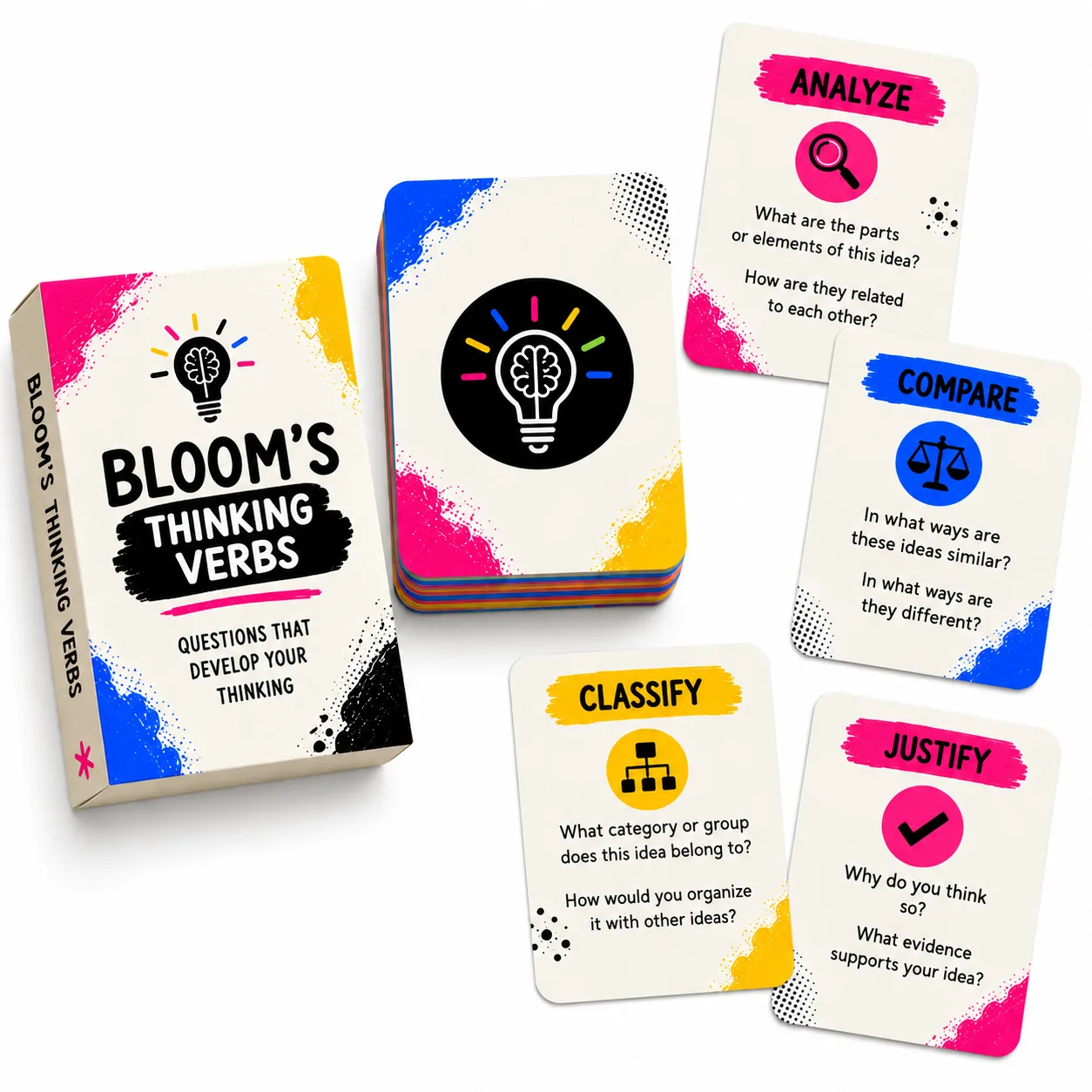
Bloom Cards — for calibrating the level of challenge
For growth mindset to develop, tasks must be difficult enough to require effort — but achievable enough not to produce abandonment. Bloom Cards generate prompts at different cognitive levels, which allows the teacher to design calibrated challenges: start at the level where the student can operate and gradually raise the demand as they gain confidence.
Common mistakes
Confusing growth mindset with positivism. Telling a student “you can do anything if you try” is not growth mindset — it is empty optimism that can be counterproductive when the student tries and does not succeed. Growth mindset does not promise that effort guarantees success: it proposes that effort, with good strategies, produces improvement. The difference matters.
Applying it only in speeches, not in practices. A teacher who talks about growth mindset but grades only the final product, praises those who finish first and responds to error with discomfort is transmitting the opposite message to the one they state. Growth mindset is built in daily practices, not in posters on the wall.
Eliminating the standard in the name of effort. Growth mindset does not mean that all effort is sufficient or that all results are equally valid. It means that the path toward the standard includes attempts, errors and progressive improvement — and that this path has pedagogical value. The standard is still the standard; what changes is how one gets there.
What competencies it develops
- When students see that their understanding changed between “before” and “now,” and connect that change to the effort they put in, they are building growth mindset as their own experience, not an abstract concept.
- When they keep working after a first error or a first failure, instead of giving up, they are training frustration tolerance: the ability to remain emotionally active in the face of adversity.
- When they try something that did not work the first time again, with a different strategy, they are exercising perseverance — not as a moral virtue but as a concrete practice that produces different results.
- When they observe their own process — what cost them, what strategy they used, what they would change — they are developing metacognition: the ability to think about their own learning, which is the foundation of any sustained improvement.
How to start
Change how errors are responded to during class. When a student answers incorrectly, ask "What led you to think that?" before correcting. That single question changes error from a failure signal to a starting point for understanding.
Add a process question to the exit ticket: "What was the hardest thing? What would you do differently?" Read the responses and mention the patterns in the next class: converts individual difficulties into collective information.
Use I Used to Think, Now I Think at the start and close of each unit. Keep the start responses and return them at the close so each student can concretely see how their understanding changed. That contrast is the most powerful evidence that capacity was built.