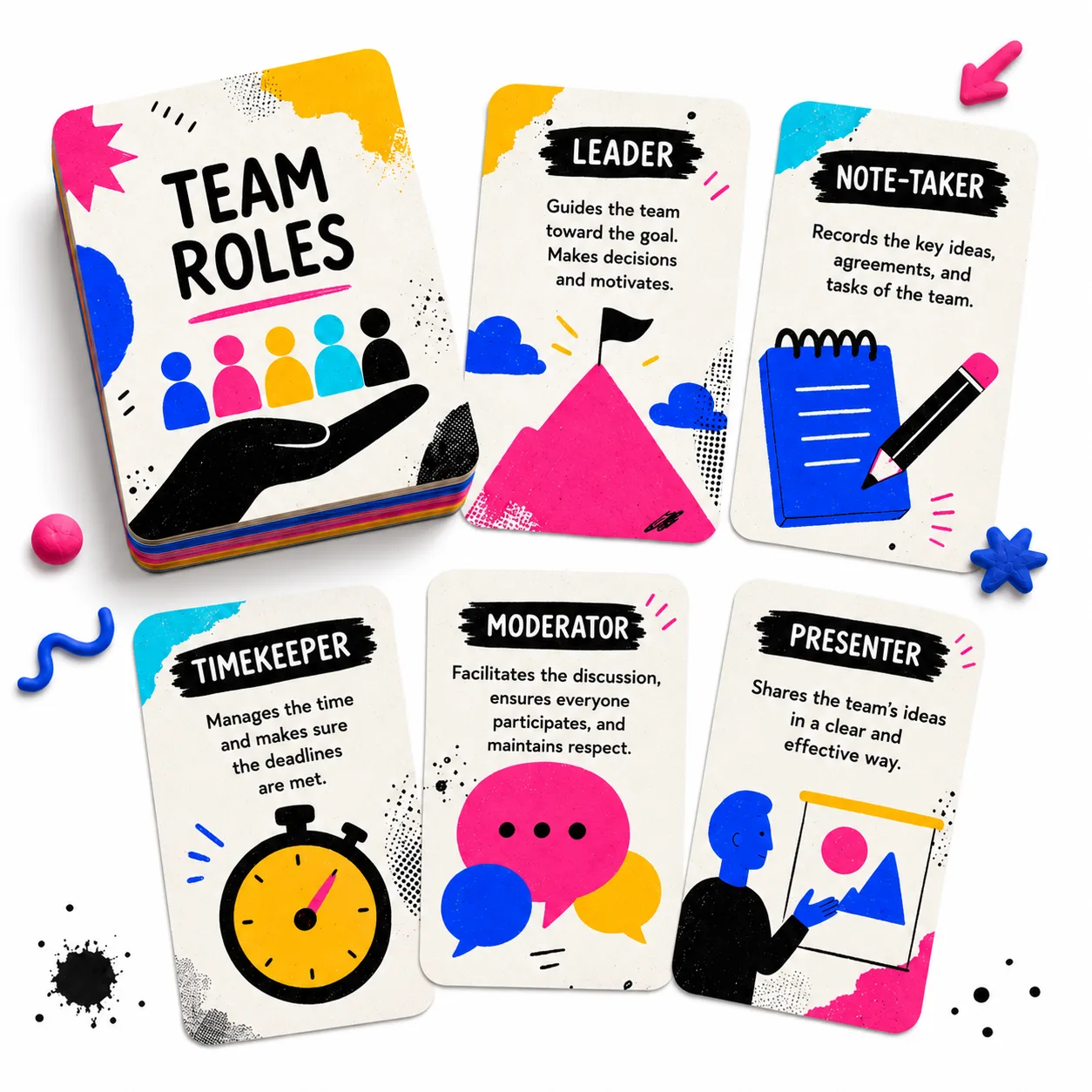
Group Role Cards for the Classroom
Role Cards structure cooperative work by assigning each group member a specific function: leader, reporter, timekeeper, devil’s advocate, note-taker, or questioner. Rather than leaving participation to spontaneous dynamics — which tend to be unequal — roles distribute responsibility concretely. The result is more equitable participation and higher quality collaborative work, because everyone knows what they are expected to contribute.
The problem with unstructured group work
Groups without explicit roles tend toward two patterns: one member does most of the work, or one voice dominates the conversation. Neither is what cooperative learning seeks. Roles solve this structurally: when someone is explicitly the reporter, they stay engaged to understand what they have to present. When someone is explicitly the devil’s advocate, challenging the group’s ideas becomes a legitimate function rather than a disruption. The structure enables participation rather than restricting it.
Rotation as a pedagogical tool
The most valuable use of the deck is not in a single session but in systematic rotation: each activity, roles are redistributed. Over the course of a unit, each student has the experience of leading, presenting, challenging, and documenting. Each function develops different skills — facilitation develops leadership; reporting develops synthesis; devil’s advocate develops argumentation; note-taking develops active listening. Rotating through all roles over the course of a unit develops a more complete set of competencies than staying in one comfortable role.
Scaffolding that becomes unnecessary
Roles are scaffolding: useful while groups learn how to work together, gradually removable as norms become established. By the end of a semester, a group that has worked consistently with role cards may not need the explicit cards to function well — the practices they represent have been internalized. That is the success metric: not perpetual dependency on the cards, but the group’s capacity to self-organize using what the roles taught them.
Frequently asked questions about Role Cards
What roles does the deck include?
The deck includes roles designed for group dynamics in academic settings. Facilitation and coordination roles: group leader (guides the discussion and ensures everyone participates), timekeeper (manages the time available for each task phase). Communication and documentation roles: reporter (presents the group's conclusions to the whole class), note-taker (records the main ideas and decisions). Critical thinking roles: devil's advocate (challenges the group's agreements and proposes alternative perspectives), questioner (formulates questions about the points discussed). The set of roles can be adjusted to the size of the group: for groups of 3, use leader, reporter, and devil's advocate; for groups of 5, incorporate all roles.
Why assign roles in group work?
Group work without assigned roles tends to fall into two patterns: some members do almost all the work and others participate minimally, or the conversation is dominated by one or two voices. Roles distribute responsibility concretely: when a student knows they have to report the conclusions to the whole class, their level of engagement changes. When someone is explicitly the devil's advocate, challenging group ideas becomes a legitimate function instead of a disruptive one. Research on cooperative learning shows that groups with explicit roles produce higher quality work and generate more equitable participation than unstructured groups.
Does assigning roles limit creativity or natural group dynamics?
It depends on how they're used. For groups that already work well together, roles can generate unnecessary friction. For groups that tend to be unstructured or where participation is unequal, roles provide a framework that enables rather than restricts. A useful middle ground is to use roles in the first group activities of the year to establish shared participation norms, and then progressively release the structure as groups show they can self-manage. Roles are scaffolding: useful while building, removable when the structure is solid.
How do students know how to fulfill their role?
The card itself includes a brief description of the role's function. It is also useful to briefly review the roles aloud before starting: what does the leader do? What does the devil's advocate do? In the first sessions with role cards, the teacher can model each role with a brief example before groups start. In subsequent sessions, students who have already fulfilled a role can explain it to those who haven't used it yet, which also reinforces their understanding of the collaborative process.
Should roles rotate between sessions?
Yes, and that rotation is one of the main pedagogical values of the cards. If the same student always takes the leader or reporter role, the growth opportunity that other roles offer is lost. The deck facilitates this rotation: each session, roles are redistributed randomly. This ensures that over the course of a unit, each student has the experience of facilitating, reporting, challenging, and documenting. Each of those functions develops different skills: facilitation develops leadership; reporting develops synthesis and oral communication; devil's advocate develops argumentation.
Can the deck be used in activities beyond group work?
Yes. In discussions or classroom debates, roles help structure participation: one student leads the discussion, another ensures all voices are heard, another records the main agreements and disagreements. In project presentations, roles define who presents which part and who responds to questions. In simulations or role plays, the cards can assign each student a specific perspective they need to represent, turning the assigned role into a mechanism for exploring multiple points of view on the same topic.
What if a student feels uncomfortable with their assigned role?
That's a valid signal and worth attending to. The teacher can allow one role swap per student per session, or establish that some roles are optional (like the devil's advocate, which requires confrontational comfort that not all students have developed at the same level). The medium-term goal is for all students to develop facility in all roles, but the path toward that goal should not be forced. A useful strategy: pair a student who is uncomfortable with a role with another who has already done it and can serve as a model.
What competencies does this activity develop?
Role Cards directly develop Collaboration (each person contributes from a specific function to a collective goal), Leadership (in its facilitation and coordination roles), Argumentation (in the devil's advocate role), and Assertive communication (in the reporter and note-taker roles). The rotation between roles develops Adaptability and empathy toward other group functions.
What pedagogies support the use of role cards in group work?
Role Cards apply principles of Cooperative Learning in its structure of positive interdependence (each role contributes something the group needs) and individual accountability (each person is responsible for their specific function). They also apply elements of Social-Emotional Learning: fulfilling roles that require listening, facilitating, or challenging others develops social and self-management competencies alongside academic ones.