Two ways of assessing, two distinct purposes
In education there are two major types of assessment: summative and formative. They are not opposites — they complement each other — but they have very different functions.
Summative assessment occurs at the end of a process (a unit, a term, a course) and its purpose is to certify what the student learned. It is the exam, the written test, the grade on the report card. It answers the question: how much did they learn?
Formative assessment occurs during the learning process and its purpose is to generate useful information to improve teaching and learning while they are happening. It answers a different question: what do I need to adjust so they learn better?
“When cooks taste the soup, that is formative assessment. When guests taste the soup, that is summative assessment.” — Paul Black
The theory behind the practice
The concept of formative assessment was introduced by Michael Scriven in 1967 and developed in the classroom context by Paul Black and Dylan Wiliam. Their 1998 meta-analysis, Inside the Black Box, reviewed more than 250 studies and concluded that formative assessment produces learning gains equivalent to between 6 and 9 additional months of schooling.
What makes formative assessment effective, according to Wiliam, is not the tool or format, but a three-step cycle:
- Gather evidence of what students understand at that moment
- Interpret that evidence in relation to the learning objectives
- Act accordingly: adjust teaching, regroup, re-explain, change strategy
Without the third step, there is no formative assessment — only data collection.
The differences in practice
| Summative assessment | Formative assessment | |
|---|---|---|
| When it occurs | At the end of the unit or period | During each class |
| Main purpose | Certify and grade | Guide and adjust teaching |
| Type of information | Final result | Ongoing process |
| What is done with the result | A grade is recorded | What comes next is modified |
| What student error indicates… | A deficiency | A learning opportunity |
| Frequency | Periodic (weekly, monthly) | Continuous (several times per class) |
Both are necessary. Summative assessment serves a legitimate accreditation function. The problem appears when it is the only form of assessment available, because the information arrives when the learning process is already over.
Three moments for formative assessment
Formative assessment integrates naturally into three moments of the class:
At the start: activate and diagnose
Before teaching new content, it is useful to know what prior knowledge the group has and what misconceptions may exist. A live word cloud makes this possible in 60 seconds: a question is launched (“What word do you associate with ecosystem?”) and responses group themselves visually. The most frequent ones appear larger, giving a quick map of the starting point.
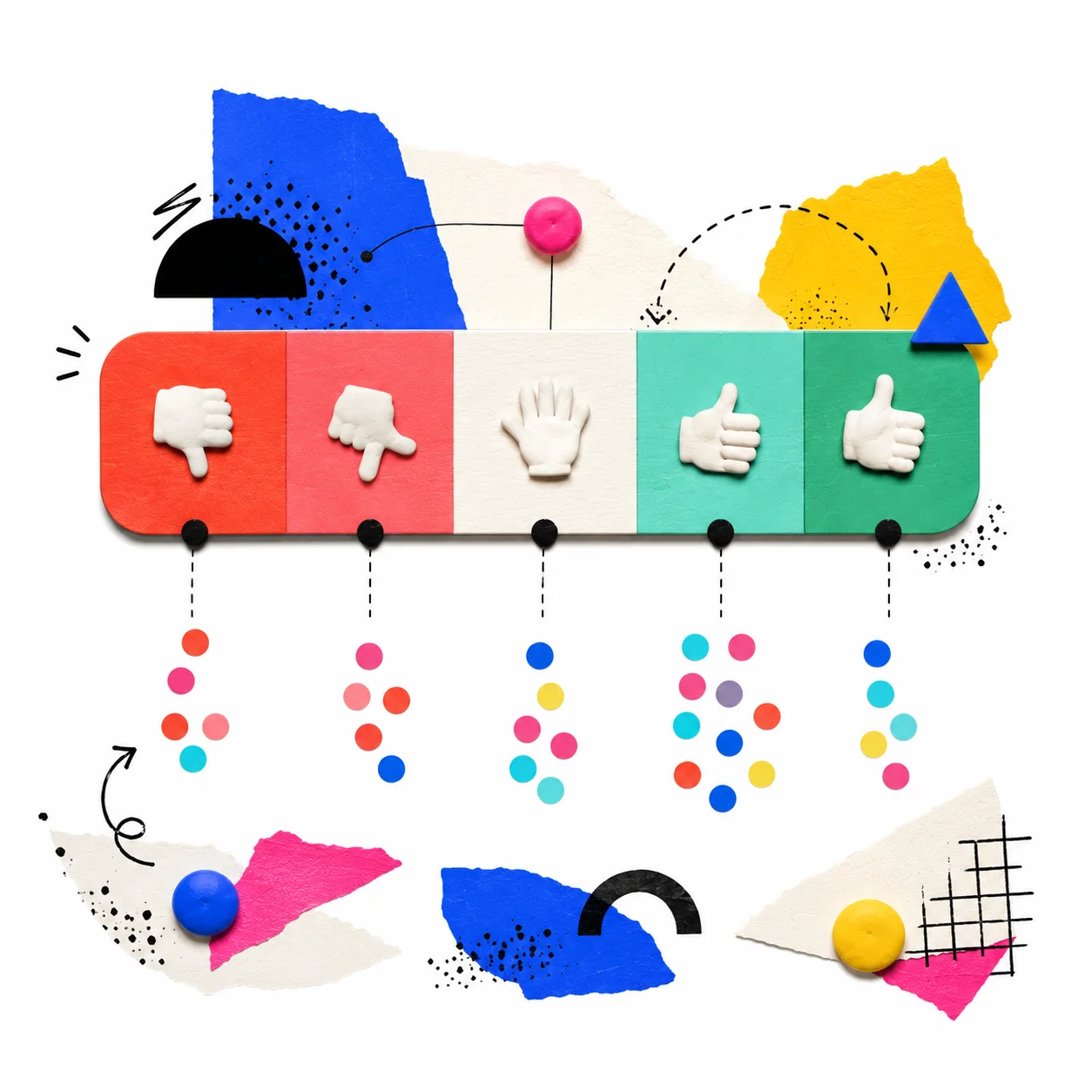
To explore deeper understanding, an agreement scale with a deliberately ambiguous or false statement reveals misconceptions: “Antibiotics are used to cure the flu” (1 = strongly disagree, 5 = strongly agree). The distribution of responses clearly shows where to begin the explanation.
During class: monitor understanding
This is the moment where formative assessment has the greatest impact. The question “Did everyone understand?” rarely generates useful responses. Techniques like the comprehension stoplight offer an alternative: students indicate green (I understood), yellow (I have doubts) or red (I did not understand) from their phone, without registration needed. In 30 seconds, the teacher has a visual reading of the group and can decide whether to continue or stop and re-explain.
The opinion thermometer works similarly but on a continuum: “How confident do you feel about being able to solve this type of problem on your own?” The visual distribution shows not only who understood, but the group’s level of confidence — an indicator that binary questions do not capture.
At the close: consolidate and plan
The exit ticket is one of the most studied techniques in formative assessment. It consists of a single question in the last minutes of class — not a recall question (“What did we see today?”) but an application question: “Explain in your own words why…”, “Give an example of…”, “What would happen if…?” The teacher reviews the responses and uses that information to plan the next class.
A collaborative ideas wall serves a complementary function: it allows collecting questions, doubts or reflections anonymously. This is especially useful for capturing what students are not willing to ask aloud, and for identifying patterns that would otherwise go unnoticed.
Free tools for each moment of the class
Comprehension Stoplight — during the explanation
Allows students to indicate their level of understanding in real time by choosing green, yellow or red. The teacher sees the group’s distribution instantly and can decide whether to move forward or stop. It is the simplest tool to start with: it is projected, students vote from their phone, and in 30 seconds there is a visual diagnosis of the entire class. Ideal for use after each key concept.
Opinion Thermometer — for taking the group’s pulse
Students position their response on a visual continuum (for example, from “not at all confident” to “very confident”). Unlike the stoplight, which offers three discrete options, the thermometer captures degrees of intensity. It is especially useful for confidence questions (“How prepared do you feel for the exam?”) or opinion questions (“How relevant does this topic feel for your life?”).
Agreement Scale — at the start, for diagnosing
Presents a statement and students position themselves from 1 to 5 (strongly disagree to strongly agree). Its greatest value is in diagnosing misconceptions: by formulating deliberately false or ambiguous statements (“Antibiotics are used to cure the flu”), the responses reveal what prior ideas need to be worked on before advancing with the topic.
Exit Ticket — at the close, for planning
A question students answer in the last minutes of class. The key is in the type of question: not recall but application, explanation or transfer (“Explain in your own words why…”, “Give an example of…”). The teacher reviews the responses — generally in less than 10 minutes — and uses that information to plan the start of the next class.
Live Word Cloud — at the start or at the close
Students send a word or short phrase and responses group themselves visually: the most frequent ones appear larger. Works well at the start of class to activate prior knowledge (“What do you know about this topic?”) and at the close to synthesize (“What word sums up what you learned today?”). The collective visualization generates an immediate map of the group’s state.
Collaborative Ideas Wall — for capturing what is not said aloud
A shared space where students post ideas, questions or reflections that everyone can see. Its main function is to collect doubts, confusions and unexpected connections anonymously. This lowers the participation barrier and allows the teacher to identify patterns that would otherwise go unnoticed.
Common mistakes when implementing it
Confusing the tool with the practice. Using a digital application to collect responses is not, by itself, formative assessment. What is formative is the complete cycle: gathering evidence, interpreting it and acting. If information is gathered but nothing is done with it, the process is incomplete.
Assuming that “no grade” equals “formative.” The difference between summative and formative assessment is not whether a grade is assigned, but the purpose: is the information used to certify or to improve the process?
Applying it only at the end of class. Formative assessment is most effective when frequent and brief. Teachers who integrate it smoothly do micro-checks every 10-15 minutes, sometimes with digital tools and sometimes with simple techniques like individual whiteboards, thumbs up or well-designed oral questions.
What competencies it develops
Formative assessment does not only improve content understanding — it also activates transversal competencies naturally:
- When a student evaluates their own level of understanding (for example, by marking “yellow” on a stoplight), they are exercising metacognition: the ability to think about their own thinking.
- When they compare their responses with the group’s on an ideas wall and adjust their understanding, they are practicing self-regulation.
- When an exit ticket asks them to reformulate what was learned in their own words, they are developing the competency of learning to learn.
These competencies are what allow students to become progressively more autonomous in their learning process.
How to start
One technique, applied consistently, is enough to begin:
The comprehension stoplight after each explanation. It is visual, fast and requires no registration.
Add the exit ticket at the close of each class. Review the responses and use them to open the next class.
Design hinge questions for key concepts — multiple-choice questions where each distractor corresponds to a specific thinking error, which allows diagnosing not only whether the student was wrong, but why.
Consistency matters more than quantity. One technique well-applied every day generates more impact than several tools used sporadically.