The student who processes the world differently
There is a student who covers their ears when the class makes noise. Another who needs you to repeat the instructions in exactly the same way every time. One who does not make eye contact but understands everything that is said. Another who completely dysregulates when an expected activity is cancelled. This is not bad behavior or lack of effort: it is that their nervous system processes information differently.
ASD (Autism Spectrum Disorder) affects approximately 1–2% of the population (CDC, 2023). In a class of 30 students, there is a real probability that one has ASD, whether or not they have a formal diagnosis. And the teacher, with or without specific training, is in charge of that student every day.
This guide is not about diagnosis or therapy — that is specialists’ territory. It is about what a teacher can do within the classroom, with the resources they have.
What ASD is (and what it is not)
ASD is a spectrum, not a single category. This means there is no such thing as “the autistic student”: there are people with completely different functional profiles who share some characteristics in common. A student with ASD may be very verbal or non-verbal. They may have high academic performance or need intensive support. They may be hypersensitive to noise or actively seek it.
What most people with ASD do share are differences in two areas:
- Communication and social interaction: difficulty reading implicit social cues, maintaining reciprocal conversations, interpreting figurative language (metaphors, irony, sarcasm) or understanding the unwritten rules of the group.
- Behavioral patterns and interests: strong preference for routines and predictability, intense responses to changes, very specific and deep interests, and differences in sensory processing.
Many authors prefer to speak of “differences” rather than “deficits” because what is an obstacle in one context can be a strength in another. A student with a high capacity for attention to detail, memory for systems and rigorous logic has characteristics that in the standard classroom are perceived as rigidity, but in another context are assets.
What ASD is not: common misinterpretations
“They have no empathy.” This is one of the most harmful ideas about autism. People with ASD feel deeply, but what they sometimes find difficult is reading the implicit signals of another’s emotional state. This is not a lack of affective empathy: it is a difference in cognitive empathy.
“If they can do X, they can do Y.” ASD is highly contextual. A student can function calmly in a structured activity and completely dysregulate in an unstructured one. Capacities are not uniform or constant: they depend on the level of sensory, social and executive demand of the moment.
“It is a tantrum.” What looks like a tantrum can be a regulatory crisis (meltdown): an involuntary response to sensory or emotional overload, not a manipulative strategy. The key difference: tantrums stop when what was wanted is obtained; meltdowns continue even when what was requested is given, because the nervous system has already dysregulated.
“They need to be in a special class.” Most students with ASD benefit from the regular classroom with appropriate supports. Segregation is not the default solution: environmental adaptations are usually the most effective first step.
How a student with ASD processes the world
Many students with ASD are hyper- or hyposensitive to sensory stimuli: classroom noise, fluorescent lighting, the texture of a uniform or the smell of a marker can be literally painful or paralyzing. A student who seems "disconnected" may be managing a sensory overload that the teacher does not perceive.
Routines are not a whim but regulation tools. When the world is predictable, the nervous system can dedicate resources to learning. When there are surprises or unexpected changes, those resources go toward managing the uncertainty. A last-minute room change can cost more cognitive energy than an entire class.
"One moment" can literally mean 60 seconds. "You're almost done" makes no sense if it is not known how much is left. Figurative language, irony and ambiguous instructions generate genuine confusion, not disobedience. Clear, concrete, step-by-step instructions are easier to process, not a simplification.
Strategies for the environment
The environment is the most modifiable factor. Before trying to change the student, change the conditions.
Reducing the sensory load
It is not possible to eliminate all stimuli from the classroom, but unnecessary ones can be reduced:
- Seat the student away from the door, windows with exterior activity or a noisy fan.
- Allow the use of noise-cancelling headphones during individual work.
- Anticipate high-stimulation situations (events, schedule changes, visits): the student needs to know in advance what is going to happen.
- If there are stimuli that cannot be eliminated (bell, recess noise), announce them before they occur.
Organizing the space visually
The space should communicate by itself what is done in each area. Signs with images, labels on materials, a class routine always visible in the same place on the wall. Visual predictability reduces the need to ask, which reduces the social load.
Having a regulation space
A quiet corner where the student can go when they feel they are getting overloaded is not a privilege — it is a self-regulation tool. It is not abandoning the class: it is preventing a larger crisis. Previous agreement with the student about when and how to use it.
The sensory board
For students who need physical input to regulate, the sensory board offers controlled stimulation they can use without leaving the class. It channels the sensory need without interrupting the activity: the student touches, presses or manipulates materials on the board and returns to the work.
Strategies for communication
Concrete, step-by-step instructions
“Take out your notebook, open it to page 47 and copy the title” is better than “prepare to work.” Vague instructions generate anxiety because the student does not know exactly what is expected. Write them as well as say them: when the instruction disappears from auditory memory, it remains visible on the board.
Avoiding figurative language without explanation
“We need to step it up,” “this goes in one ear and out the other,” “can you pay attention?”: these phrases can cause literal confusion. If they are used, explain what they mean. Over time the student learns common expressions, but at the start they need the explicit translation.
The emotions deck
Many students with ASD have difficulty identifying and naming what they feel. The deck cards offer a concrete visual repertoire: pointing is more accessible than verbalizing. When the student can show a card instead of explaining their emotional state, it lowers the entry barrier and opens a possible conversation.
The kanban board as visual support
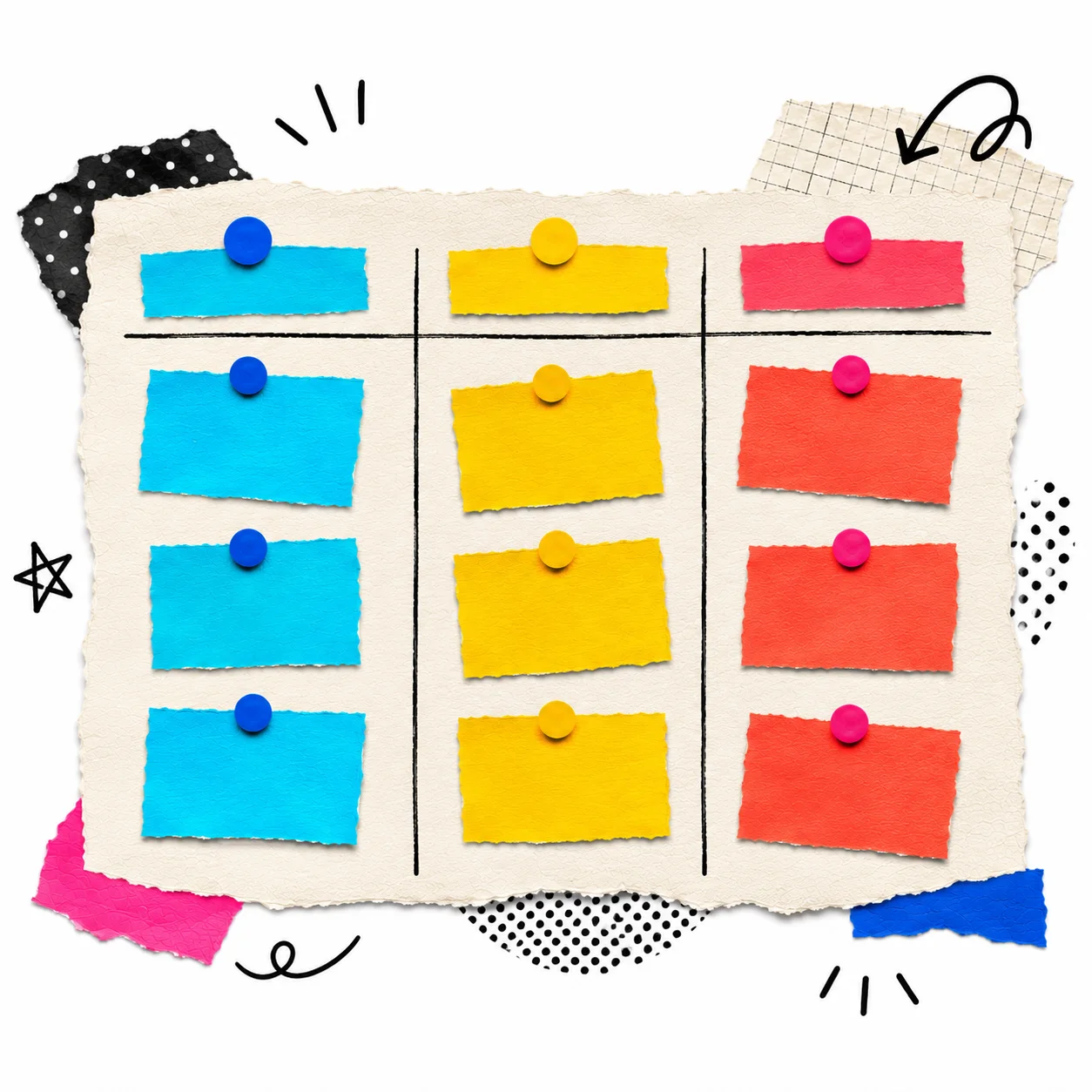
“Take out your notebook, open it to page 47 and copy the title” disappears from auditory memory before finishing. The kanban board makes visible what needs to be done, what is in process and what is done: the student does not need to retain the instruction because they have it in front of them. The visual structure replaces working memory.
Processing time
Students with ASD often need more time to process a question before responding. Silence after a question is not a sign that they do not know: they may still be processing. Wait 10–15 seconds before reformulating or moving to another student.
The comprehension stoplight
For students with difficulties verbalizing or who feel embarrassed asking for help, the comprehension stoplight is a low social-cost means of expression: green (I understand), yellow (somewhat), red (I am lost). No need to speak or draw attention. The student signals and the teacher knows how to approach.
Strategies for transitions and routines
Transitions (from one activity to another, from the classroom to recess, from recess to the classroom) are high-risk moments for dysregulation. Three concrete strategies:
The visual timer in transitions
“In 5 minutes we finish this and move to mathematics” is not just information — it is real time for internal preparation. The visual timer converts that notice into something visible: the student can see the time reducing and prepare for the change before it arrives. For a nervous system that needs predictability, seeing the time is qualitatively different from hearing it.
The exit ticket as a closing ritual
Always ending the same way reduces the uncertainty of “what comes next?” to something known and predictable. The exit ticket is that ritual: a brief question, always at the end, that tells the student the class ended completely. The repetition of the ritual is part of what makes it effective.
Announce changes in advance. If tomorrow there is a schedule change, say so today. If the class is going to be different, explain how. A surprising change is much more costly than an anticipated one.
Specific interests as a gateway
Many students with ASD have very intense and specific interests: dinosaurs, trains, astronomy, video games, mathematics, maps. These interests are not obstacles — they are concentrated motivation.
Using them as a gateway to content is a powerful and underused strategy. Can the student obsessed with planets write their expository text on the solar system? Can the one who knows everything about dinosaurs present the Cretaceous extinction as an example of historical change? The interest is the scaffold, not the destination.
What competencies it develops — in the whole class
Working with students with ASD not only attends to an individual need. It is a practice that strengthens key teacher competencies for any classroom.
- Emotional regulation: learning to read another’s state without that person verbalizing it requires fine attention to non-verbal behavior. That trained reading improves the regulation of the whole group.
- Nonverbal communication: designing alternative communication systems (stoplights, cards, gestures) expands the teacher’s communicative repertoire beyond words.
- Self-regulation: anticipating transitions, maintaining routines and modulating one’s own tone during a regulatory crisis are self-management practices that become second nature over time.
- Frustration tolerance: accompanying a student who cannot communicate what is happening, who dysregulates without apparent warning, develops a tolerance capacity that translates into greater patience with everyone.
- Active listening: the student with ASD does not always speak. Learning to listen without words, through behavior and context, is the deepest form of active listening.
What works for ASD works for everyone
As with ADHD, the strategies that help a student with ASD improve the environment for the whole class:
Written step-by-step instructions help any student who missed the verbal instruction. Anticipating activity changes reduces the anxiety of the whole group. Having a predictable start and close routine gives structure to those who need it and does not bother those who do not. The regulation space can be used by any student who needs it.
This is Universal Design for Learning in action: designing for whoever needs it most benefits everyone.
How to start
Start announcing transitions 5 minutes in advance and writing the order of the day at the start of each class. These are two routine changes that cost nothing and have an immediate impact on the student's anxiety level.
For one week, observe which instructions generate confusion or need to be repeated. Rewrite them in concrete, numbered steps. Add the board as a permanent support for the day's instructions.
Ask the student (or their family) what their specific interests are and find a way to incorporate them into at least one activity per unit. That connection changes the relationship with learning.
The student with ASD does not need the teacher to be a therapist. They need a predictable environment, clear instructions, anticipated transitions and an adult who distinguishes between cannot and will not, and who finds the entry point that for that specific student has the right key.