The problem with the group grade
A teacher assigns a team project. Four students work for two weeks. One researched, wrote and assembled the presentation. Another helped for half the process. The other two put their names on it. All four receive the same grade.
The student who did almost everything feels cheated. Those who did nothing learned they can get away with it. And the teacher knows the grade does not reflect reality — but has no way of proving it.
This is not a minor problem. When group assessment is unfair, it destroys the motivation of those who work the most and reinforces passivity in those who contribute the least. Over time, teachers stop assigning group projects — not because they do not work, but because they do not know how to assess them fairly.
The theory behind the practice
Johnson and Johnson (1999), the most cited researchers in cooperative learning, identified that individual accountability is one of the five essential conditions for group work to function. Without it, the “free rider effect” appears: some members reduce their effort because they know others will compensate.
Slavin (1995) demonstrated that cooperative learning methods that combine group goals with individual accountability produce significantly superior results to those that only assess the group product. The key is not to eliminate the group grade — it is to complement it with individual evidence.
Webb (2009) added an important nuance: it is not enough to divide tasks and add individual grades. What makes group work valuable is elaboration — explaining, discussing, questioning and building on others’ ideas. Assessment should capture this process, not just the final product.
Group grade + individual grade: how to combine them
The solution is not to choose between group or individual grade — it is to combine both with clear criteria.
| Component | What it assesses | Suggested weight | How evidence is collected |
|---|---|---|---|
| Group product | Quality of the final result | 40-50% | Rubric applied to the product |
| Group process | How they worked together | 20-30% | Kanban, meeting records, observation |
| Individual contribution | What each person did | 20-30% | Self-assessment + peer assessment + evidence |
| Individual reflection | What each person learned | 10% | Exit ticket or written reflection |
This structure makes the invisible visible: the process. An excellent project done by one person does not receive the same grade as an excellent project done by everyone. And a student who contributed significantly to a mediocre project is not penalized for the group’s result.
Three levels of group assessment
Level 1: Product + individual reflection (the simplest)
The teacher assesses the group product with a shared rubric from the start. At the end, each student completes an exit ticket answering three questions: What did I do in this project? What did I learn? What would I do differently?
The final grade combines the product rubric (70%) with the individual reflection (30%). It is the simplest format to start with and already introduces an individual dimension.
Level 2: Product + visible process + peer assessment
In addition to the product rubric, the team uses a kanban board throughout the project. Each task has an owner and a status (to do, in progress, finished). When assessment time comes, the kanban objectively shows who did what.
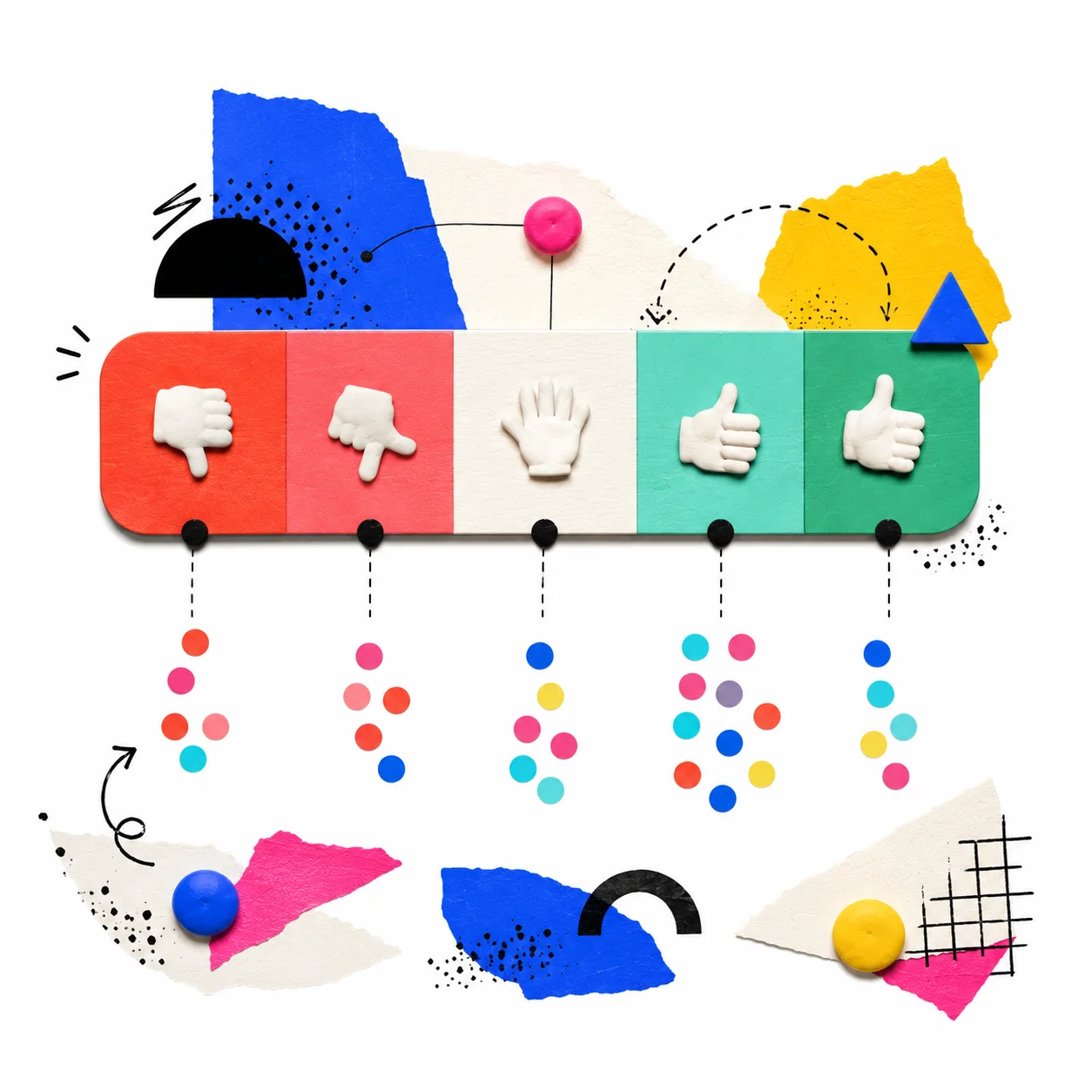
An agreement scale is added where each member rates their teammates’ contributions on specific criteria: “Completed their tasks on time” (1-5), “Contributed ideas in meetings” (1-5), “Helped others when needed” (1-5). The ratings are confidential.
The grade combines: product (40%) + process/kanban (30%) + peer assessment (30%).
Level 3: Comprehensive assessment with roles and presentation
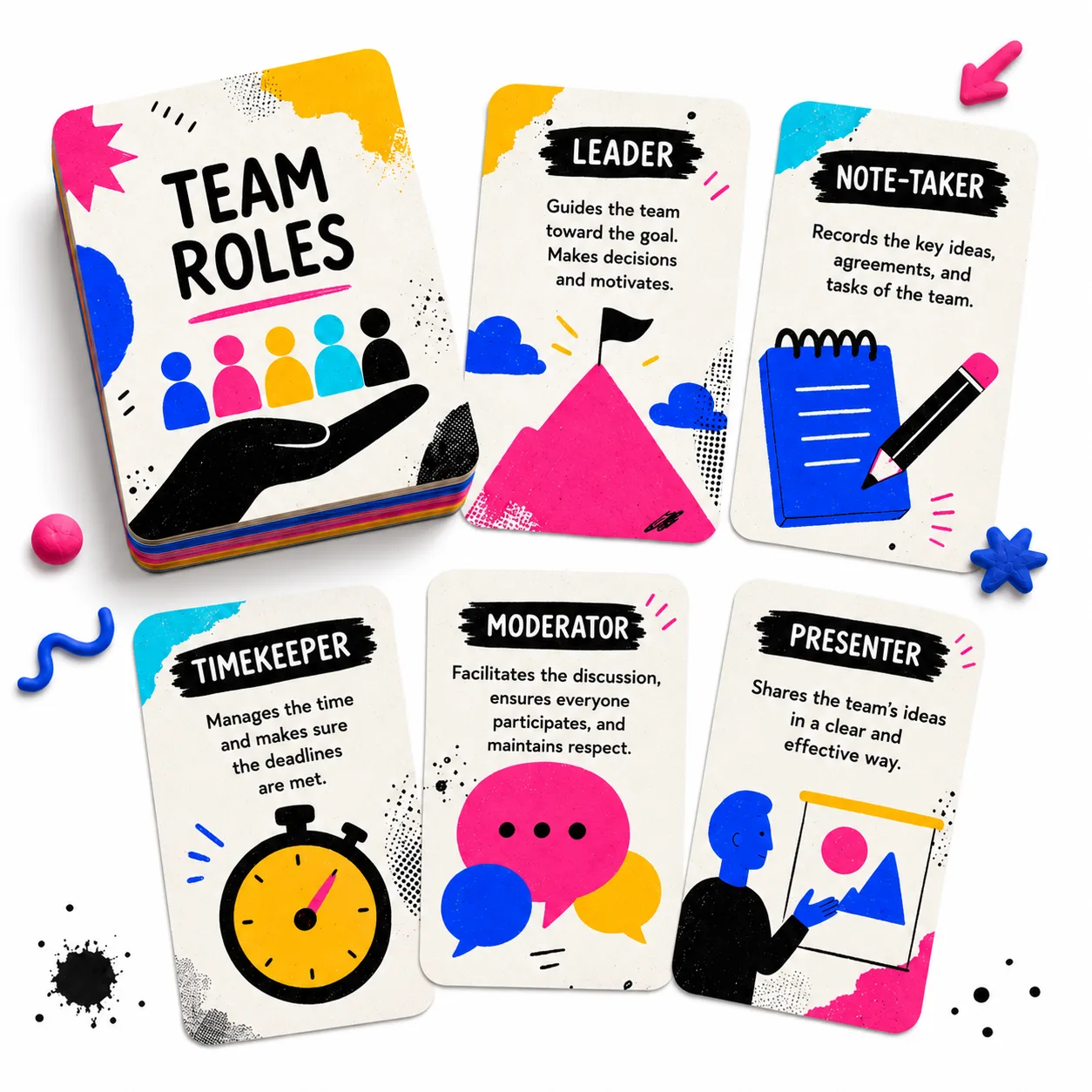
Each member has an assigned role with role cards (facilitator, researcher, communicator, reviewer). The rubric includes specific criteria by role.
The project is presented in a work gallery where each group exhibits and the rest asks questions and gives feedback. The public presentation adds an assessable dimension: not only what they did matters, but how they communicate it.
Combined: product (30%) + role performance (25%) + presentation (20%) + peer assessment (15%) + individual reflection (10%).
How to design the product rubric
A useful rubric for group projects has four characteristics:
It does not say "good quality" — it says "includes at least 3 verifiable sources and cites them correctly."
Students receive it the day the project is assigned, not the day it is assessed. The rubric is not just an assessment tool — it is an orientation tool.
Each criterion has 3-4 levels with concrete descriptions. "Excellent / Good / Fair / Insufficient" says nothing. "Presents an argument with 3 or more pieces of evidence / with 1-2 pieces of evidence / without evidence" says something.
At least one criterion assesses how they worked: task distribution, time management, resolution of internal conflicts.
Free tools for each phase
Kanban Board — for making the process visible
Throughout the project, the team records tasks, owners and statuses on a kanban. It is not bureaucracy — it is transparency. When a member says “I didn’t know what to do,” the kanban shows whether the tasks were assigned. When another says “I did everything,” the kanban confirms or refutes it. It is the most powerful tool for converting impressions into evidence.
Role Cards — for assessing functions, not just results
Each member receives a role with clear responsibilities. The facilitator coordinates meetings. The timekeeper manages time. The recorder documents decisions. The critic reviews quality before submitting. When assessing, the teacher does not ask “did you work?” but “did you fulfill your role’s functions?”
Work Gallery — for adding the communicative dimension
The project culminates with a presentation where each group exhibits their work and the rest browse, observe and ask questions. The public presentation is an assessable instance in itself: can they explain what they did? Can all members answer questions? If only one person can explain the project, that is evaluative information.
Agreement Scale — for peer assessment with criteria
Each member confidentially rates their teammates’ contribution on 3-5 specific criteria, on a scale from 1 to 5. “Fulfilled what was agreed,” “Listened to others’ ideas,” “Offered solutions when there were problems.” The averages reveal patterns: if three members agree that one did not participate, that convergence is significant.
Exit Ticket — for individual reflection
At the close of the project, each student writes individually: what they did, what they learned, what they would do differently and what working with their team gave them. This reflection serves two functions: it is evidence of individual learning and a metacognitive instance that closes the cycle.
Priority Voting — for assessing decision-making
At the start of the project, the group decides democratically what aspects to prioritize. This process — discussing options, arguing preferences, reaching agreements — is assessable. Did everyone participate in the decision? Did they consider different perspectives? The quality of the decision-making process predicts the quality of the subsequent work.
Common mistakes when assessing group projects
Assessing only the final product. A brilliant project can hide a terrible process (one person did everything) and a mediocre project can be the result of enormous learning (everyone worked on something new for them). Without assessing the process, the grade lies.
Not giving criteria in advance. When students do not know what criteria they will be assessed on, they work blind. The rubric shared from day one is not a favor — it is a condition for the assessment to be fair.
Relying only on peer assessment. Peer assessment is valuable but not infallible. Friends over-rate each other and personal conflicts distort ratings. That is why it works as a complement, not as the only indicator.
Penalizing the whole group for one member. If one student did not work, the others’ grades should not drop because of it. A system with an individual component protects those who contributed.
Not assessing conflict. Disagreements within the group are not failures — they are learning opportunities. Assessing how they resolved their differences is as important as assessing what they produced.
What competencies it develops
Fair assessment of group projects does not only measure — it also teaches:
- When a team uses a kanban to distribute tasks and each member takes responsibility for theirs, they are exercising real collaboration, not just physical proximity.
- When a student assesses a classmate’s work with criteria and not impressions, they are practicing applied critical thinking.
- When they reflect on their own contribution and what they learned, they are developing self-regulation — the ability to monitor their own performance.
- When the team faces a disagreement over priorities and reaches an agreement without teacher intervention, they are practicing negotiation and mediation.
- When they present the project before other groups and answer questions, they are developing oral expression in an authentic context.
How to start
Add an individual exit ticket at the end of each group project. Three questions: what did I do? what did I learn? what would I do differently? Use the responses to adjust up to 30% of the group grade.
Implement a kanban board during the project. The kanban does not change the pedagogy — it changes the visibility. With process evidence, assessment stops being guesswork.
Combine product rubric + roles + peer assessment + individual reflection. Share all criteria from the start and dedicate one class to explaining how the system works. Transparency in assessment teaches as much as the project itself.