The problem with “teaching critical thinking”
“Developing critical thinking” appears in almost every curriculum in the world. It is also one of the most unfulfilled pedagogical promises of contemporary education. The reason is simple: critical thinking is mentioned as an objective but rarely taught as a skill.
There is no evidence that students develop critical thinking simply because the teacher tells them to “think.” In the same way that nobody learns to swim by listening to descriptions of swimming, nobody develops critical thinking without practicing specific acts of critical thinking in concrete contexts.
The good news is that critical thinking can be taught. But it requires doing something different from what is usual: instead of transmitting information and expecting students to “process” it, the teacher must design situations where critical thinking is necessary, visible and evaluable.
What critical thinking is (and is not)
Critical thinking is not synonymous with skepticism or criticizing for the sake of it. Robert Ennis, one of the reference researchers in the field, defines it as “reasonable, reflective thinking focused on deciding what to believe or what to do.” That is, thinking that examines evidence, evaluates arguments and reaches justified conclusions.
Critical thinking includes specific skills that can be practiced:
Identify premises, conclusions and logical relationships between them.
Distinguish between facts and opinions, identify reliable sources, detect biases.
Recognize what is taken for granted without being made explicit.
Make decisions with incomplete or contradictory information.
Understand positions different from one's own before rejecting them.
None of these skills develop from listening to a lecture. All require active practice with real materials.
Why critical thinking does not develop on its own
Cognitive science research identifies several reasons why critical thinking requires explicit instruction:
Human beings naturally tend to seek information that confirms what we already believe and to ignore or dismiss what contradicts it. This bias is so robust that it activates even when people know it exists. Counteracting it requires deliberate practice.
Thinking critically about a historical text does not guarantee that the student will think critically about a news article, an advertising argument or a scientific source. Critical thinking skills must be practiced in multiple domains for them to transfer.
Reading a lot does not guarantee reading critically. Discussing a lot does not guarantee arguing well. The amount of exposure to content does not, on its own, produce analysis skills — guided practice with feedback does.
Four strategies for teaching it
The thinking routines of Harvard's Project Zero (David Perkins and collaborators) are brief, repeatable structures that externalize students' thinking. Two of the most effective for critical thinking:
See-Think-Wonder: given an image, text or piece of data, students first describe what they observe objectively (See), then interpret or infer (Think) and finally generate genuine questions (Wonder). The sequence forces distinguishing between observation and interpretation, a fundamental distinction of critical thinking.
I Used to Think / Now I Think: students record their initial position on a topic, live a learning experience (debate, reading, experiment) and then record how their thinking changed and why. This routine develops metacognition about one's own process of conceptual change.
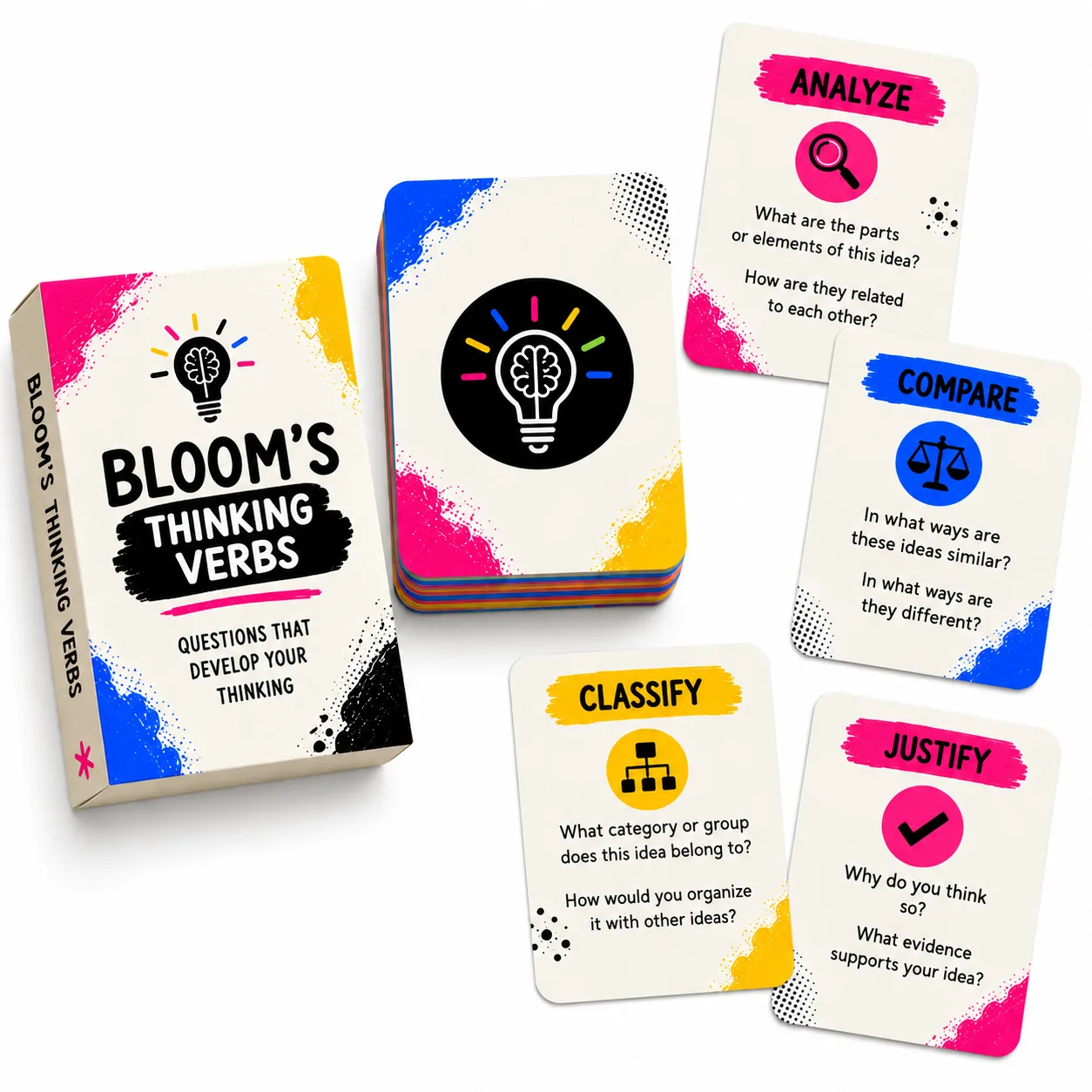
Bloom's taxonomy classifies questions in six cognitive levels: remember, understand, apply, analyze, evaluate and create. Most questions asked in class require only the first three levels. Critical thinking questions operate at the last three.
The question dice and Bloom cards allow generating high-level questions for any topic in a few seconds, without the teacher having to design them all in advance.
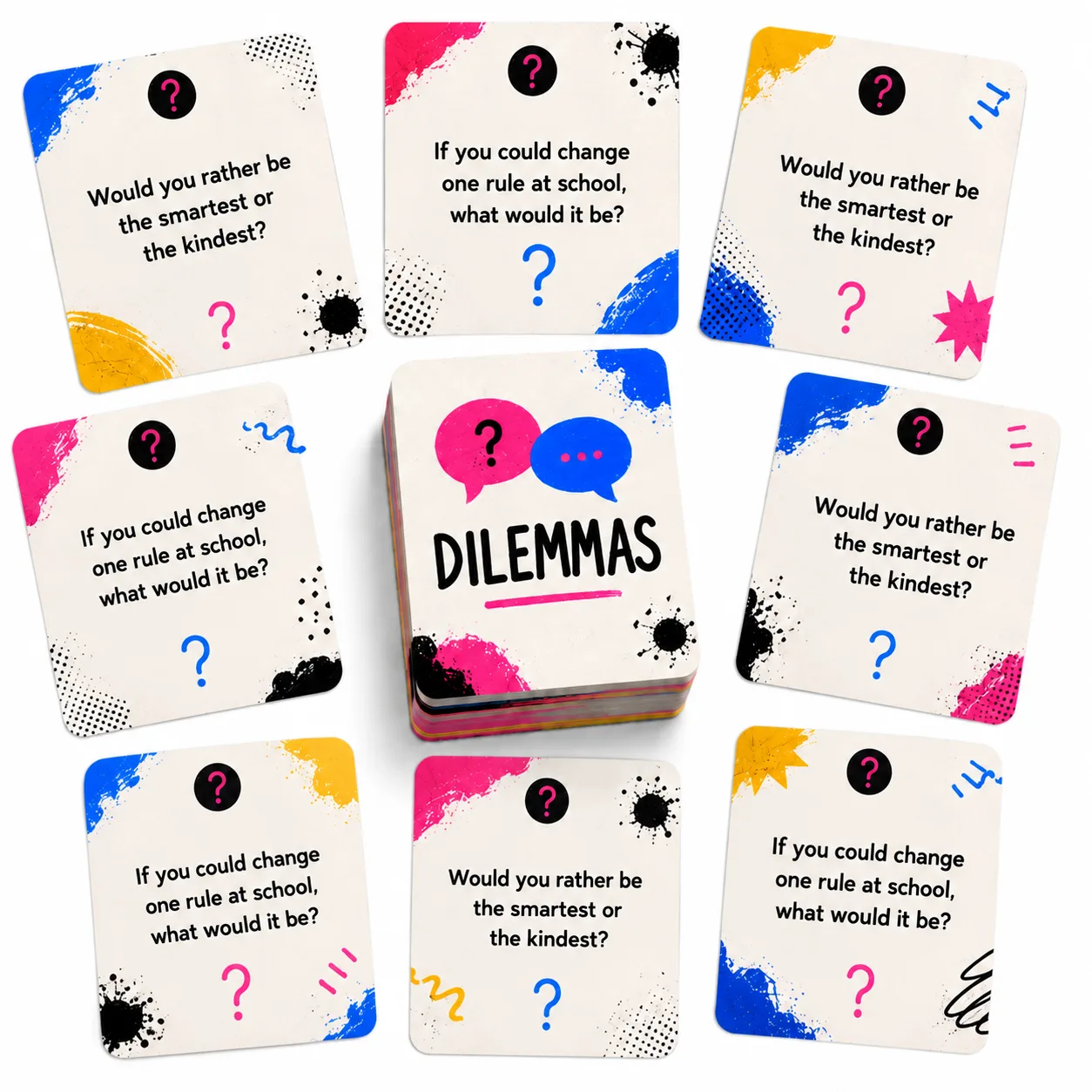
Dilemmas are situations where there are legitimate arguments in more than one direction and where the decision requires weighing values, evidence and consequences. They are the ideal material for developing critical thinking because they do not allow memory answers — they force reasoning.
Dilemma cards present situations without an obvious answer that students must analyze in small groups: What would you do? Why? What information would you need to decide with more certainty? What would you lose with each option? The discussion about the dilemma is the learning — not the answer.
The Venn diagram is a simple visual tool that externalizes comparative thinking. Comparing two sources about the same event, two positions on the same problem or two apparently similar concepts forces precise analysis. The question "how are they similar and how do they differ?" automatically activates higher analysis levels than "what does each one say?".
A particularly effective variant: compare two contradictory sources on the same topic and ask the group to identify what each one assumes, what data it ignores and what questions would need to be answered to decide which is more reliable.
The silent debate as a tool for deep analysis
The silent debate is one of the most underused techniques for critical thinking. The teacher launches a controversial statement on a shared wall (“Technology makes young people less able to concentrate” or “Art should be a mandatory subject at all levels”). Students respond in writing, with arguments. Others read and respond to others’ arguments, also in writing.
Writing forces precision in reasoning in a way that speech does not require. You cannot be vague in writing in the same way you can be vague out loud. Furthermore, the written record allows the teacher to identify exactly where there are reasoning errors, unexamined assumptions or poorly used evidence.
How to integrate critical thinking into any subject
The frequent mistake is treating critical thinking as a separate subject (“one hour a week of critical thinking”). Research suggests it works better integrated into the curricular content of each discipline:
- In Science: evaluate research methodologies, identify confounding variables, analyze why two studies reach different conclusions
- In History: compare historical interpretations, identify the author’s point of view, evaluate the reliability of sources
- In Language Arts: analyze the arguments of a text, identify logical fallacies, evaluate the evidence supporting a thesis
- In Mathematics: analyze whether the solution to a problem makes sense in the real context, identify implicit assumptions in problem formulation
In all cases, the principle is the same: ask not only “what is the answer?” but “how do you know that is the answer? What tells you that? What information would change your conclusion?”
Free tools to practice it in class
Dilemma cards — to reason without a single answer
Dilemma cards present situations without an obvious answer that students analyze in small groups: What would you do? Why? What would you lose with each option? The discussion is the learning — not the answer. They are the ideal material for developing critical thinking because they force reasoning with real tension.
Question dice — to scale cognitive demand
Each face of the dice corresponds to a level of Bloom’s taxonomy. The question dice generates questions of analysis, synthesis and evaluation in seconds for any content. Allows replacing recall questions (“What is X?”) with real thinking questions (“Why X and not Y? What would change if…?”).
Venn diagram — to compare with precision
The Venn diagram externalizes comparative thinking. Comparing two contradictory sources, two positions on a problem or two similar concepts forces precise analysis. The question “how are they similar and how do they differ?” activates higher analysis levels than “what does each one say?”.
Bloom cards — to order cognitive demand
Bloom cards organize questions by cognitive level and allow scaling the requirement of any topic. The teacher can choose the level needed according to the moment of the class: comprehension questions at the start, evaluation questions at the close.
Silent debate — to argue in writing
The silent debate launches a statement on a shared wall and students respond with written arguments. Writing forces precision in reasoning in a way that speech does not require. Furthermore, the written record allows identifying exactly where there are logical errors or unexamined assumptions.
Collaborative ideas wall — to make collective thinking visible
The collaborative ideas wall allows students to post questions, hypotheses and counterarguments in a shared space. Its function in critical thinking is to surface what each student thinks before discussion, making visible the diversity of perspectives in the group.
Common mistakes
Assuming critical thinking means having an opinion. Having an opinion is not critical thinking — everyone has opinions. Critical thinking begins when the evidence supporting that opinion is examined and one is willing to change it if the evidence is sufficient.
Using it only with “humanistic” topics. Critical thinking is as necessary in mathematics or science as in history or philosophy. Evaluating whether the result of a problem makes sense, analyzing the assumptions of a scientific model or detecting errors in mathematical reasoning are all critical thinking exercises.
Not giving feedback on the reasoning process. The teacher who only evaluates whether the conclusion is “correct” or “incorrect” is not developing critical thinking — they are evaluating memory. Useful feedback focuses on reasoning: “what evidence did you use to reach that conclusion?” or “did you consider the possibility that…?”
What competencies it develops
- When students analyze an argument, identify its premises and evaluate whether the conclusion follows from them, they are developing critical thinking in its most precise sense.
- When they build their own argument with evidence and defend it against objections, they are practicing argumentation as a communicative competency.
- When they evaluate the reliability of a source before using it, they are exercising critical reading — an essential skill in the era of misinformation.
- When they reflect on how they reached a conclusion and what led them to change their position, they are developing metacognition: the capacity to think about one’s own thinking.
How to start
Critical thinking does not require redesigning all planning — it can be integrated with small changes:
Replace two low-level questions in the next class with analysis or evaluation questions. The question dice generates these alternatives in seconds.
Use dilemma cards with small groups. A single card can generate 15 minutes of genuine discussion if the teacher asks the right questions during the close.
Implement a visible thinking routine (such as I Used to Think / Now I Think) at the start and close of each unit. Within a few weeks, students internalize the structure and can apply it autonomously.