The excitement of the beginning always fades
First day of the project: students are enthusiastic. They choose topics, make plans, organize with energy. Second week: enthusiasm drops. Third week: “When does this end?” Fourth week: half want to quit.
This pattern is not a failure — it is predictable. Novelty activates dopamine. But dopamine runs out. What begins as excitement needs to become something else to sustain itself: purpose, visible progress, social connection, sense of competence. If the only motivation was novelty, the project dies when the novelty disappears.
The challenge is not how to start with enthusiasm — that is easy. The challenge is how to sustain commitment when the excitement of the beginning has passed and the hard work remains.
The theory behind the practice
Deci and Ryan (1985, 2000) developed Self-Determination Theory, which identifies three basic psychological needs for intrinsic motivation:
- Autonomy: feeling I have control over what I do
- Competence: feeling I can do it and that I am improving
- Relatedness: feeling I matter and belong to the group
When one or more of these needs is frustrated, motivation drops — regardless of how interesting the activity is. A student who has no choice (no autonomy), who feels unable to handle the task (no competence) or who does not matter to anyone (no relatedness) will disconnect. Not out of laziness — out of unmet needs.
Dweck (2006) showed that students with a growth mindset — those who believe capacity develops with effort — persist more in the face of difficulties than those with a fixed mindset. But mindset is not a personality trait — it is built with the feedback they receive. “You are very smart” fosters fixed mindset. “You can tell you worked hard on this” fosters growth mindset.
Locke and Latham (2002) found that specific and challenging goals produce higher performance than vague goals (“do your best”). But distant goals — “by end of year” — do not sustain daily motivation. What works are intermediate goals: visible milestones that mark progress.
The three phases of motivation (and what each needs)
| Phase | What happens | What the student needs |
|---|---|---|
| Start (week 1–2) | Enthusiasm for novelty | Clear direction, early quick wins |
| Plateau (week 3–5) | Novelty runs out, difficulty appears | Visible progress, choice, meaning |
| Close (week 6+) | Fatigue, wanting to finish | Near goal, real audience, celebration |
Most teachers design well for the start and the close. The plateau — where 80% of motivation is lost — goes unaddressed. The strategies below focus on that phase.
Five strategies for the plateau
When the student only sees how much is left, they get discouraged. When they see how much they have advanced, they are propelled forward. A kanban board with tasks moving from "to do" to "in progress" to "done" turns progress into something tangible. Each completed task is a small visible victory.
The key is to break the project into small tasks. "Research the topic" is an enormous and paralyzing task. "Find 3 reliable sources," "Read the first source and note 2 ideas," "Write the first paragraph of the draft" are three tasks that can be completed and celebrated.
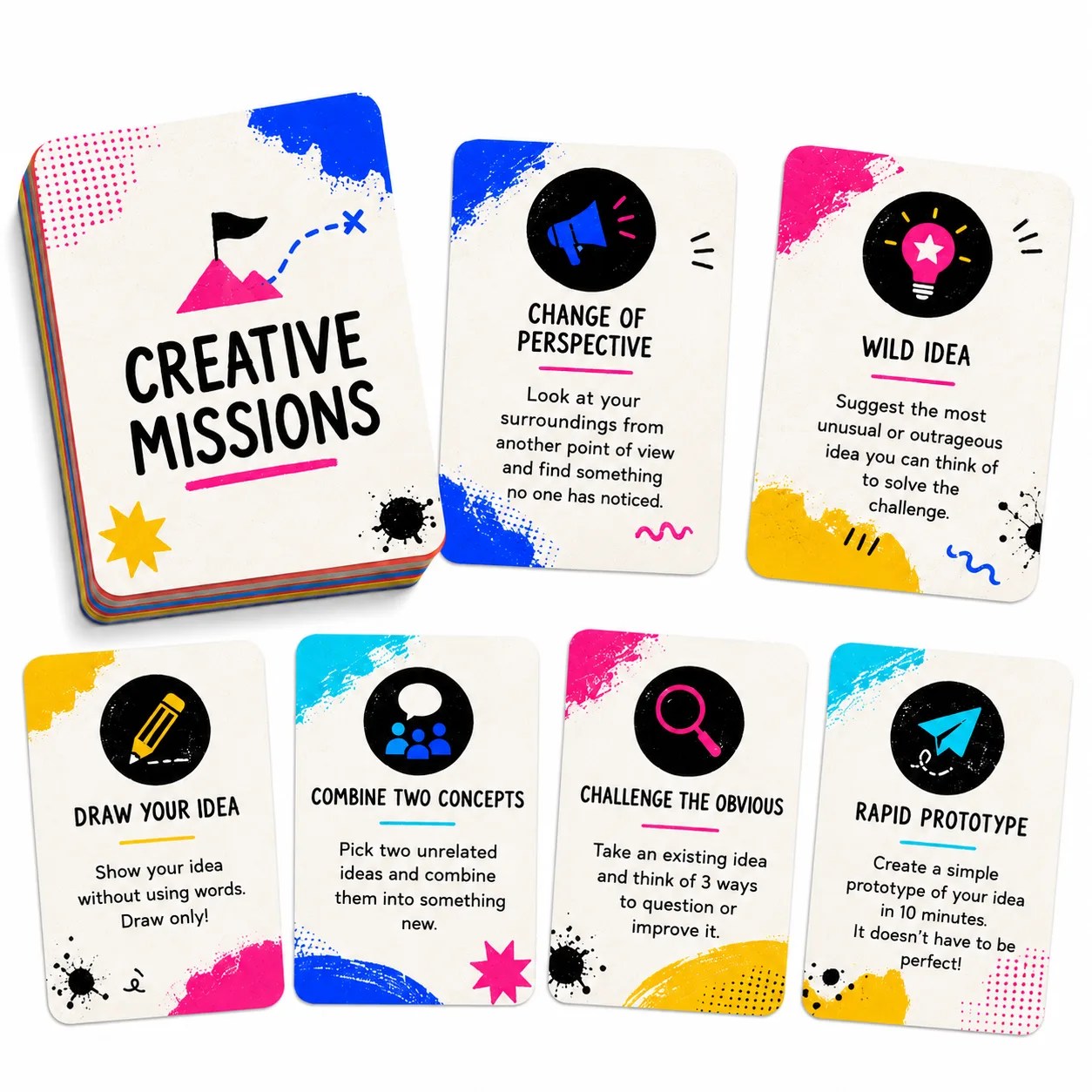
When a student feels they have no control over what they do, motivation evaporates. The choice board allows choosing how to demonstrate what was learned. Creative mission cards offer different paths to reach the same objective.
There is no need to give total freedom — sometimes it is enough to give two options where before there was one. "Do you want to write an essay or give a presentation?" "Do you prefer to work on this individually or in pairs?" Micro-choice reactivates agency.
Predictability kills attention. If students know exactly what is going to happen, they stop paying attention. A question die that introduces randomness into the review, a session where instead of working on the project they discuss obstacles, a class where the teacher asks teams to present their progress to the group — any variation breaks the inertia.
The visual timer also helps: dividing an 80-minute session into 20-minute blocks with different objectives maintains energy. Each block has a mini-close and a mini-start.
Students work differently when they know someone else will see their work. A work gallery at the end of the project is motivating, but waiting until the end is too late for the plateau. Creating intermediate exposure moments sustains commitment:
- Peer review mid-project
- 3-minute progress presentation per group
- Publishing progress on a visible classroom wall
When work has an audience — classmates, other classes, families — it stops being an administrative task for the teacher and becomes something that matters.
Many students give up not because they cannot, but because they believe they should not be stuck. "If I were good at this, it would not be this hard." That belief — fixed mindset — is combated explicitly:
- "It is normal that this is difficult. You are learning something new."
- "Being stuck does not mean you cannot. It means you are at the edge of what you know."
- "Where exactly are you stuck? Let's resolve that."
Process feedback ("you can tell you dedicated time to this part") sustains motivation better than result feedback ("you got an 8") and much better than person feedback ("you are very smart").
Free tools for sustaining engagement
Kanban Board — tangible progress
The kanban turns abstract advance into visible movement. Each task that moves from “to do” to “done” is a concrete achievement. For long-term motivation, the kanban answers the most important question: “Am I advancing?” When the answer is visible, motivation is sustained even through difficult moments.
Choice Board — structured autonomy
When motivation drops, adding options reactivates it. The board does not say “do whatever you want” — it says “choose between these equivalent options.” The choice is limited (4–6 options) but real. This satisfies the need for autonomy without losing pedagogical direction.
Creative Mission Cards — renewable novelty
Each mission transforms a familiar activity into something unexpected. When the third week of research feels repetitive, a creative mission changes the frame without changing the content: “You are journalists who must write a story about their discovery” instead of “Write a summary of what you researched.” The task is the same; the energy is different.
Work Gallery — audience and meaning
Knowing that others will see the work changes how it is worked on. The gallery can be used at the end, but also mid-project as a “public progress review.” Students exhibit what they have so far, receive feedback and return to the project with renewed information and motivation.
Question Dice — randomness against routine
When class becomes predictable, the dice introduce productive uncertainty. Which question will come up? Whose turn will it be? Randomness activates attention by anticipation. It works especially well for reviewing content or checking project progress: the die chooses which aspect of the project is discussed today.
Visual Timer — manageable blocks
An 80-minute session of “work on the project” is an invitation to drift. Four 20-minute blocks with specific objectives are four opportunities for achievement. The timer sets the pace, creates productive urgency and allows mini-closes where the student evaluates their progress before continuing.
Common mistakes when trying to sustain motivation
Adding more rewards. When motivation drops, the temptation is to offer points, stickers, prizes. The problem: external rewards erode intrinsic motivation (Deci et al., 1999). Once the rewards disappear, motivation falls lower than it was before starting. The question is not “what reward do I give them?” but “what need am I not meeting?”
Making everything more fun. Fun is a transitory emotion — not a strategy. Turning every class into a show exhausts the teacher and teaches students that it is only worth participating when something is entertaining. Sustained engagement comes from purpose, progress and autonomy — not from constant fun.
Blaming students. “They’re not interested in anything,” “This generation can’t concentrate.” Motivation is not a student trait — it is a design result. If 25 of 30 students disengage in week 3, the problem is not the 25 — it is week 3.
Not anticipating the plateau. If the teacher designs a 6-week project thinking the enthusiasm of day 1 will sustain itself, the drop is inevitable. Anticipating the plateau — and planning injections of choice, variation and visible progress in weeks 3 and 4 — makes the difference.
Giving feedback only at the end. A project that receives feedback only when the final version is submitted loses all opportunities for adjustment and intermediate motivation. Timely feedback — during the process, not just at the close — sustains direction and energy.
What competencies it develops
Sustaining commitment beyond novelty is itself one of the most important competencies:
- When a student keeps working on a project despite the initial excitement having faded, they are exercising perseverance — the capacity to continue when the easy thing would be to quit.
- When they understand that getting stuck is part of the process and not a sign of inability, they are building growth mindset — the conviction that effort produces improvement.
- When they choose a different path on the choice board or propose a solution to an obstacle, they are practicing initiative and proactivity.
- When they break a large project into manageable tasks and organize them on a kanban, they are developing goal planning — thinking in steps, not just in results.
- When they face a difficulty, get frustrated and keep going instead of quitting, they are exercising frustration tolerance — a competency not taught with speeches but with experiences of overcoming.
How to start
Instead of a single final submission, create 3–4 partial deliveries with specific dates. Each partial delivery is a moment of visible progress and timely feedback. The kanban visualizes these milestones.
When you notice enthusiasm dropping (week 3, typically), add a micro-choice: "How do you want to present this progress?", "Do you want to continue with the same format or try another?" One single choice can reactivate energy.
Replace "Very good" and "You're missing something" with specific observations of effort and strategy: "You can tell you revised this several times — the clarity improved a lot," "What strategy did you use to resolve that part?" This type of feedback builds growth mindset and sustains motivation long-term.
Motivation is not something students bring or do not bring — it is something the class design sustains or destroys. The teacher cannot control the student’s emotion, but can design conditions where commitment is fed by purpose, progress and belonging instead of depending on novelty that always runs out.