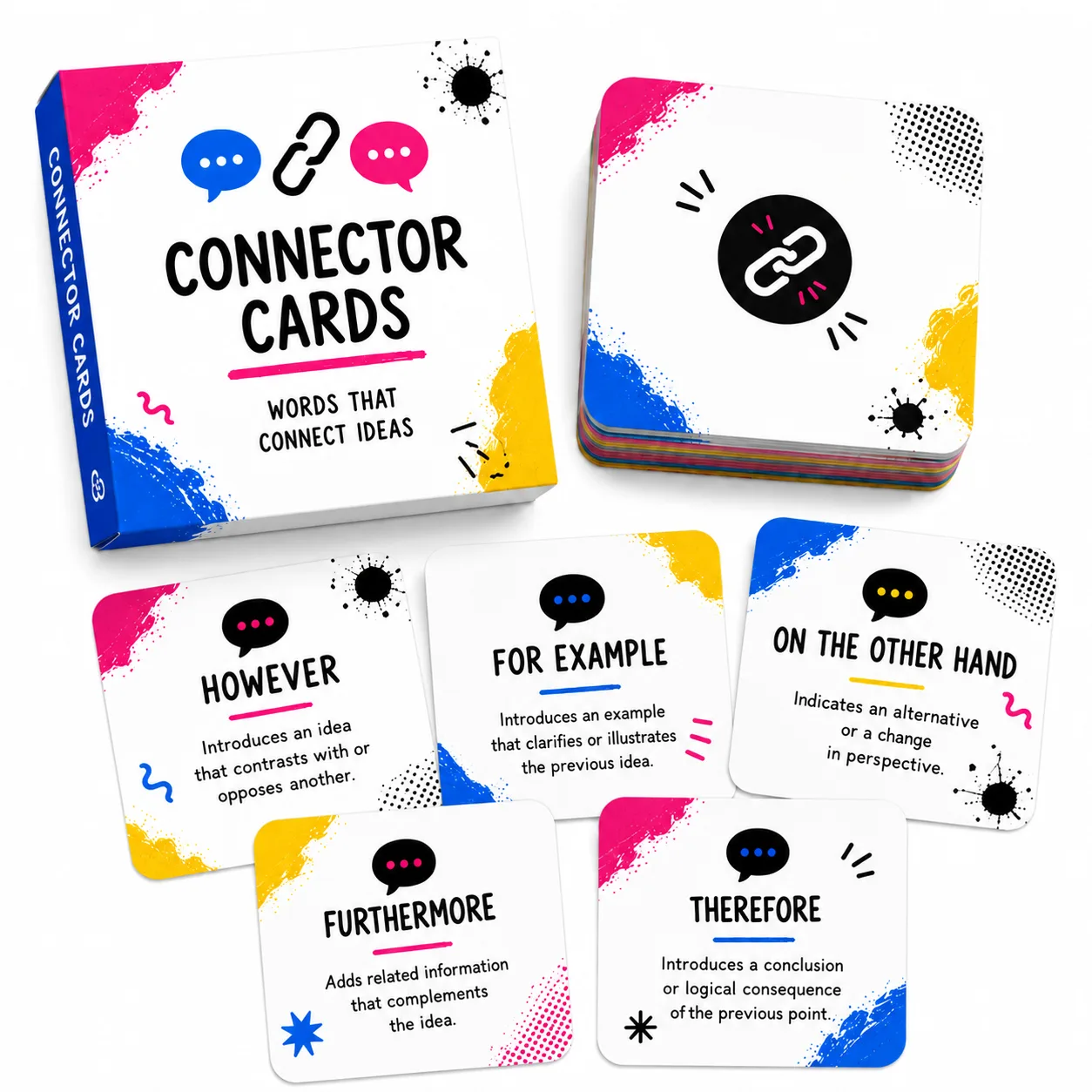
Text Connector Cards for the Classroom
Connector Cards turn the learning of text cohesion into a practical, immediate activity. Instead of memorizing lists of connectors, students use them in context: draw a card, read the connector, and build a sentence that uses it correctly. The activity works both for oral expression and argumentative writing, and is equally useful in primary and secondary school.
Connectors for argumentation: the challenge of using them well
Most students know words like “however”, “therefore”, or “on the other hand”, but use them incorrectly or avoid them out of insecurity. The problem is not vocabulary but understanding the logical relationship each connector establishes: contrast, consequence, addition, exemplification. The cards make that function explicit alongside the connector, which allows students to make conscious decisions about what type of relationship they want to mark between their ideas.
From isolated sentence to coherent text
The deck scales well to different levels of complexity. In the simplest version, each student builds a sentence with their card’s connector. In the most advanced version, the group builds a collective argumentative text where each person adds a sentence using the connector they drew, linking it to the previous one. The result is a text with varied cohesion that the group can analyze together.
Revision and self-correction of texts
One of the most productive uses of the deck is in draft revision: students mark the connectors they have already used, identify which categories predominate and which are absent, and then draw cards to incorporate connectors from the missing categories. This process turns revision into an active editing activity, not just simple reading.
Frequently asked questions about Connector Cards
What are text connectors and why are they difficult to teach?
Text connectors (also called discourse connectors or discourse markers) are words or expressions that indicate the logical relationship between two ideas: contrast (however, although, but), addition (furthermore, also, likewise), causality (because, therefore, consequently), exemplification (for example, that is, such as), or conclusion (in summary, in short, finally). They are difficult to teach because the difference between 'however' and 'although', or between 'therefore' and 'consequently', is not lexical but pragmatic: it depends on what type of logical relationship is being established and what position it occupies in the sentence. Learning them from a list does not work; learning them by using them in context does.
What connectors does the deck include?
The deck includes connectors from the categories most used in academic and argumentative writing: contrast (however, although, despite, nevertheless, on the other hand), addition (furthermore, also, moreover, even), causality and consequence (because, since, therefore, consequently, so that), exemplification (for example, that is, such as, in particular), order and structure (first of all, on the one hand, in conclusion, finally), and condition (even though, provided that, on the condition that). Each card shows the connector and its function so students understand what type of logical relationship they are marking.
How do you use the deck to practice argumentative writing?
The most direct exercise is sentence completion: the teacher or student draws a card, reads the connector, and must build a sentence that uses it correctly. For example, if 'however' comes up, the student writes two contrasting ideas. A more advanced variant is chain writing: each student draws a card and adds a sentence to the text being built collectively, using their card's connector to link it to the previous sentence. This works both the individual connector and the overall coherence of the text.
Does it also work for oral expression?
Yes, and it is often the best entry point before moving to writing. The teacher projects the deck and draws a card: the student whose turn it is must continue an argument already in progress using that connector. For example, if someone just said 'Technology facilitates learning' and the card 'however' comes up, the next student must argue the contrast. This oral dynamic works as a warm-up and quickly reveals which connectors students master and which need more work.
For which educational level is it appropriate?
From upper primary through university. In primary, the most basic connectors (but, also, because, first, then, finally) are worked on with short sentences about everyday topics. In secondary, more formal connectors (nevertheless, consequently, likewise) can be incorporated and practiced in longer argumentative texts. In higher education, the deck is useful for reinforcing academic writing, especially with students who already know the connectors but use them incorrectly or avoid them out of insecurity.
How do you use the deck to correct common connector errors?
One very effective approach is active correction: the teacher draws a card with a connector the group tends to misuse (for example, 'however' used where 'although' would be correct) and asks students to explain when each is used correctly. Another variant is showing two sentences with different connectors (but / however) and asking students to explain what changes. The most common errors the deck helps address are: using 'since' when 'because' is correct, confusing 'therefore' with 'however', or using 'also' when the function is to expand rather than simply add.
Can it be integrated into the correction of already-written texts?
Yes, it is one of the most efficient uses. When students finish a draft, the teacher asks them to mark all the connectors they used and count how many are of the same type. Then the group draws three cards from different categories and the challenge is to review the text and incorporate at least one of those connectors where it improves cohesion. This turns text revision into an active activity rather than passive reading, and directs attention to the logical structure of the argument rather than just spelling or vocabulary.
What competencies does this activity develop?
Connector Cards directly develop Argumentation (linking ideas with explicit logical relationships), Purposeful writing (using the appropriate connector according to communicative intent), and Assertive communication (structuring ideas clearly and orderly). In oral variants they also develop Oral expression and, when evaluating others' sentences, Critical thinking.
What pedagogies support the use of connector cards?
The connector deck applies principles of Question-Based Learning (each card generates the challenge of building a coherent sentence) and Experiential Learning (connectors are learned by using them in context, not by memorizing them). The group dynamic of evaluating whether the connector is well used activates principles of peer Formative Assessment. In its collective writing version, it also applies elements of Cooperative Learning.