The problem: expressing opinions is not arguing
“What do you all think about this?” The teacher poses the question and receives what is expected: “It’s fine,” “It’s wrong,” “I like it,” “I don’t.” If pushed a little — “Why?” — the answer is almost always the same: “Because,” “I just don’t like it,” “I don’t know, it’s what I think.”
This does not mean students cannot argue. It means nobody taught them the difference between an opinion and an argument, or gave them tools to move from one to the other. An opinion is saying what you think. An argument is explaining why you think it, with reasons another person can evaluate.
The difference seems subtle but is enormous. An opinion cannot be discussed — it is personal. An argument can — it can be questioned, strengthened, refuted or accepted. Argumentation is the foundation of democratic thinking, conflict resolution and deep learning.
The theory behind the practice
Kuhn (1991) studied how people of different ages argue and found that most — including adults — confuse opinions with arguments, do not consider counterarguments and cannot distinguish between evidence and belief. The conclusion was clear: the ability to argue does not develop spontaneously — it needs explicit instruction.
Mercer (2000) demonstrated that when students learn “ground rules” for argumentative dialogue (give reasons, ask for reasons, consider alternatives), the quality of reasoning improves significantly across all subjects, not just language arts.
Reznitskaya and Gregory (2013) identified the elements of an “inquiry community” where argumentation flourishes: open questions that admit multiple responses, explicit norms of dialogue, and the expectation that every claim comes with a reason.
The progression: from opinion to argument
| Level | The student says… | What they need to advance |
|---|---|---|
| Opinion | “I think it’s wrong” | One question: why? |
| Opinion with reason | “It’s wrong because it harms people” | A structure: reason + evidence |
| Argument | “It’s wrong because it harms people. For example, in the case of…” | A challenge: what if someone thinks the opposite? |
| Argument with counter-argument | “Some say that… but I think that… because…” | Sustained practice |
This progression does not happen naturally — it is built with activities designed for each level.
Four strategies that work
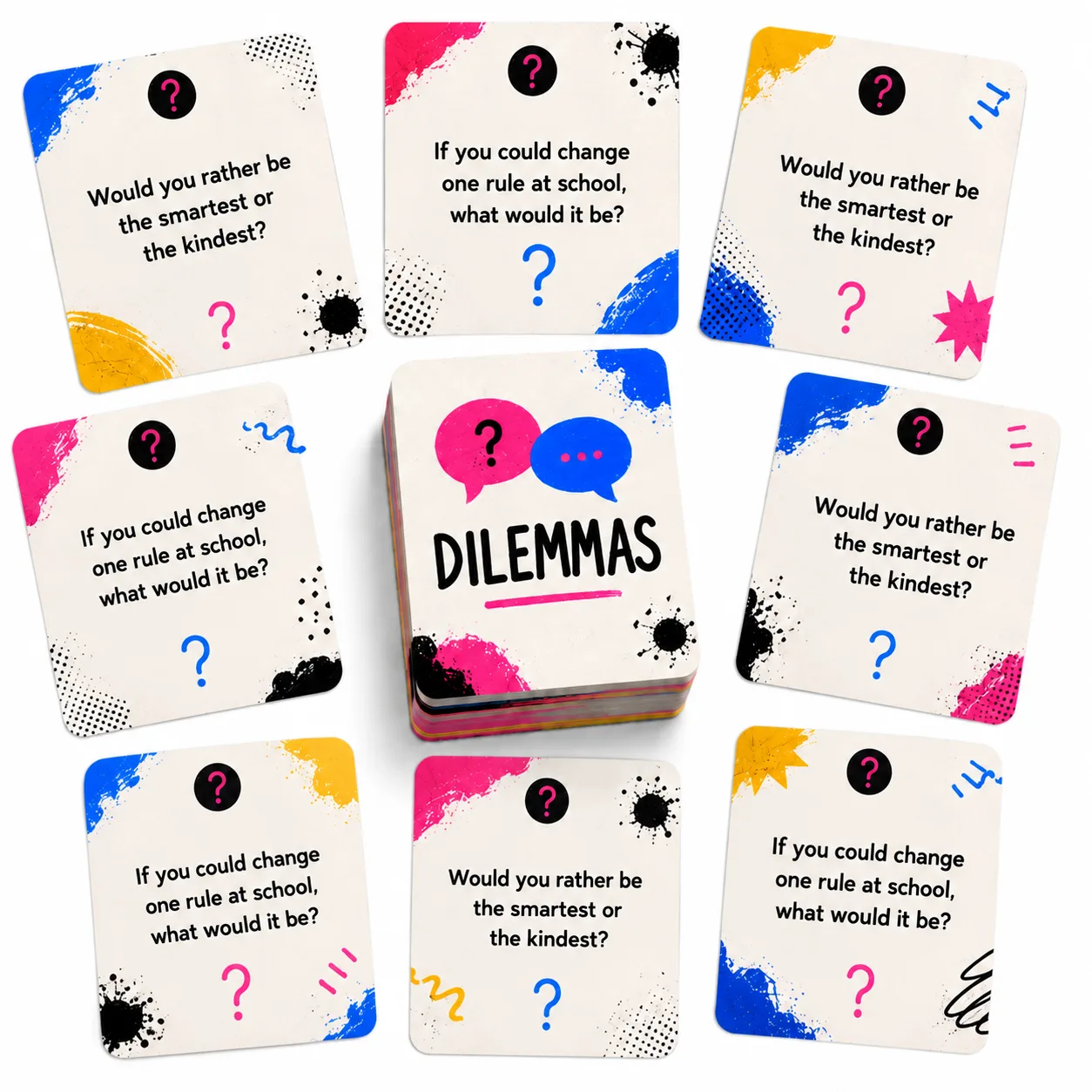
Students do not argue when the answer is obvious. Dilemma cards present situations where there are valid arguments in more than one direction: "Is it more fair to give everyone the same, or to give each person what they need?" When there is no correct answer, the only option is to argue.
The dilemma works because it generates genuine tension that must be resolved with reasons, not preferences.
Many students know what they want to say but not how to organize it. Connector cards provide linguistic scaffolding: "I agree with... because...", "However, it is also true that...", "This demonstrates that...", "An example of this would be...".
This is not about providing empty formulas — it is about offering structure until the student internalizes it. It is the equivalent of training wheels on a bicycle: they come off when they are no longer needed.
The most powerful activity for developing argumentation is asking students to defend a position they do not hold. Debate cards assign stances at random: "Defend that..." / "Question that...".
This forces students to separate personal opinion from argumentative construction. A student who must defend something they do not believe needs to find reasons, anticipate objections and articulate a coherent position — all high-level cognitive operations.
Not all students are comfortable arguing out loud. The silent debate allows argumentation to happen in writing: students write their positions, read others' and respond — all without speaking. This equalizes participation and allows thinking before responding, something oral debate does not always permit.
Free tools for each strategy
Debate Cards — for structuring the clash of ideas
They assign argumentative roles at random (for, against, moderator, questioner). The random assignment is key: it removes the pressure of “saying what I really think” and allows practicing argumentation as a skill, not as a confession of beliefs.
Connector Cards — for giving language
They offer logical connectors that students draw at random and must use in their contribution. “However…”, “An example of this is…”, “This contradicts what was said… because…”. Connectors make the structure of thought visible and raise the quality of contributions without needing to explain grammatical theory.
Dilemma Cards — for generating genuine debate
They present situations with no correct answer. Unlike class questions that usually have an expected answer, dilemmas force students to argue because there is no way to resolve them without giving reasons. They work at any level and in any subject.
Venn Diagram — for comparing positions
Before debating, students compare two positions in a Venn diagram: what is valid about each? Where do they overlap? This prior step prevents polarization and trains the ability to recognize nuances — something quality argumentation requires.
I Used to Think, Now I Think — for recording the change
Completed before and after a debate or discussion. It makes visible that arguing well can change what one thinks — and that changing your mind in the face of good arguments is not weakness, but intelligence.
Silent Debate — for arguing without speaking
Students write their positions in a shared space and respond to others’ in writing. It is especially valuable for introverted students, for groups where a few dominate the conversation, and for sensitive topics where the distance of writing allows greater honesty.
Common mistakes when teaching argumentation
Confusing debate with a fight. Arguing is not about winning or convincing — it is about building the best possible version of an idea. When debate becomes competition, students stop listening and start attacking. Rules must be explicit: ideas are questioned, not people.
Asking for arguments without teaching the structure. Telling students who have never learned the difference between opinion and argument to “argue” is like asking them to write an essay without having read one. Connectors, models and guided practice are indispensable at the start.
Only arguing in language arts or social studies. Argumentation is transversal. In mathematics, students argue why a procedure works. In natural sciences, they argue from experimental evidence. In physical education, they argue about game strategies. Limiting argumentation to “humanities subjects” wastes half the opportunities.
Not giving preparation time. A good argument needs time to build. Asking students to argue “on the spot” favors the fastest and most extroverted students. Giving 3 to 5 minutes to think, take notes and structure before speaking improves the quality of all contributions.
What competencies it develops
Argumentation simultaneously activates several competencies:
- Whoever builds an argument with reasons and evidence is exercising argumentation as a specific competency and logical reasoning as a transversal competency.
- Whoever analyzes another’s argument to find strengths and weaknesses is practicing critical thinking.
- Whoever listens to a counter-argument without interrupting and incorporates it into their response is exercising active listening.
- Whoever articulates their position clearly in front of others is developing oral expression.
Argumentation is one of the few activities that works on all these competencies simultaneously and in an integrated way.
How to start
Present a dilemma and ask each student to write their position using at least one connector ("I believe that... because...", "However..."). No debate yet — just individual writing.
Assign positions with debate cards. Before the debate, each group has 5 minutes to prepare arguments. Afterwards, complete "I Used to Think, Now I Think."
A complex topic in writing, where students respond to each other's arguments. Argumentation matures when it is also practiced in silence.
The progression matters: first give language (connectors), then give structure (roles), then give autonomy (open debate). Skipping the first steps produces the same results as always: “Because.”