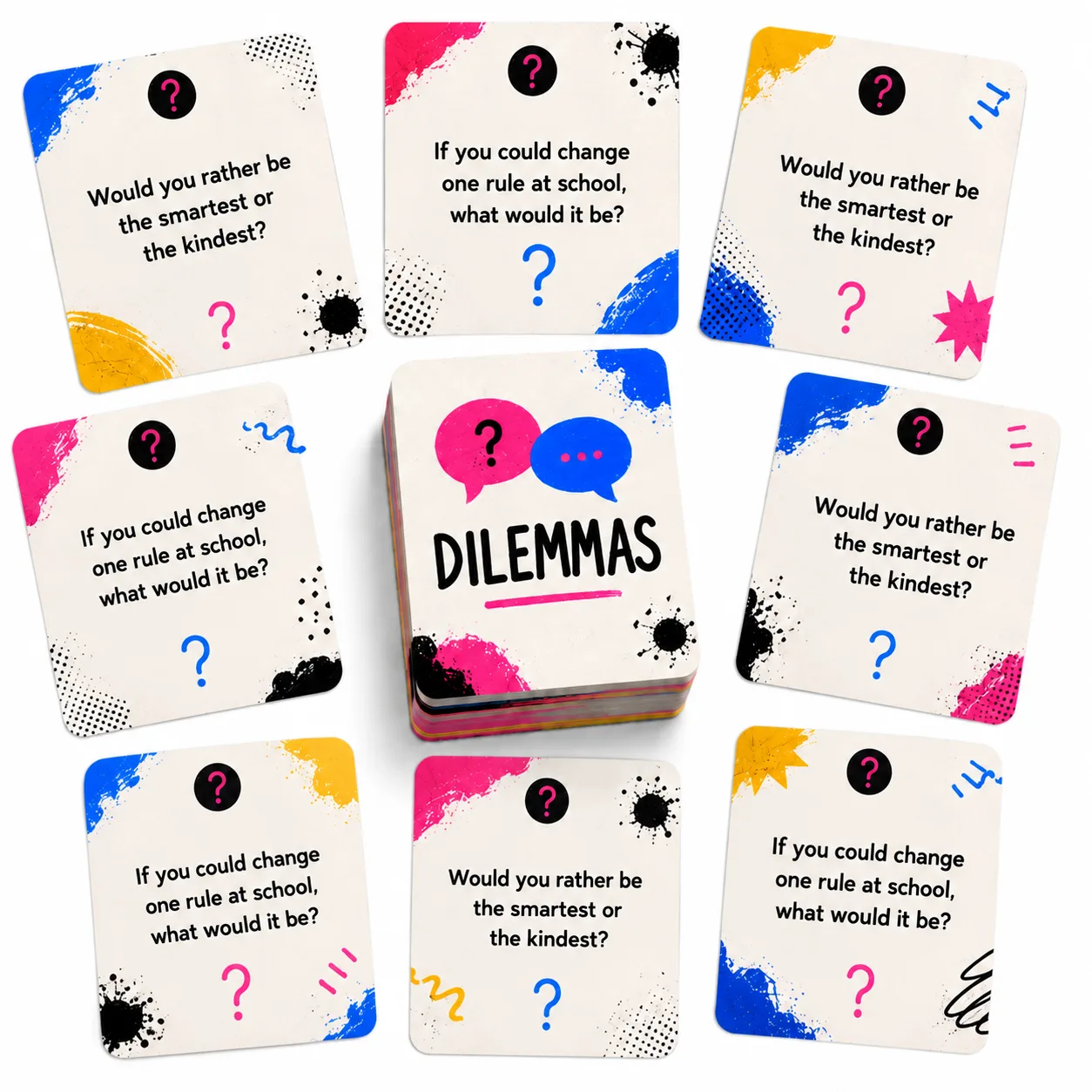
Ethical Dilemma Cards for the Classroom
Dilemma Cards present situations with no correct answer: each card describes a scenario where values are in tension and every decision has consequences. That structure generates genuine debate instead of an exchange of opinions, because the goal is not to guess the expected answer but to reason aloud together. They are especially effective with groups that already know each other, but also work as an entry point for discussing complex topics in a structured way.
Why dilemmas without a correct answer are pedagogically more powerful
When there is a correct answer, students try to guess it. When there isn’t one, they reason. The difference is not trivial: in the first case, the goal is the answer; in the second, the process of reaching it. Ethical dilemmas force students to make explicit the values guiding each decision, making visible something that normally stays implicit. When two students make different decisions faced with the same dilemma, the discussion that follows is about which values are prioritized — not about who is right.
Empathy as a cognitive exercise
One of the most powerful variants of the deck is the multiple-perspectives approach: the same dilemma is analyzed from the point of view of each person involved in the situation. This makes empathy an active exercise — taking the other’s position and thinking from their values and circumstances — rather than a declaration of intent. Students are often surprised to discover that the same situation can look completely different depending on where you stand.
Dilemmas in any subject
Ethical dilemmas are not exclusive to Ethics or Civics classes. In History, past leaders made morally complex decisions. In Science, the dilemmas of research and use of natural resources are ever-present. In Literature, characters face exactly these kinds of tensions. The deck acts as a bridge between subject content and the ethical questions that content opens.
Frequently asked questions about Dilemma Cards
What makes a situation an ethical dilemma rather than just a difficult question?
An ethical dilemma is a situation where no objectively correct answer exists because it involves values in tension: honesty vs. loyalty, individual well-being vs. collective well-being, rules vs. exceptional circumstances. Unlike a problem that has a solution if you think hard enough, a genuine dilemma can be resolved in several equally valid ways depending on which values are prioritized. That is precisely its pedagogical power: there is no correct answer the teacher can reveal at the end, which frees students to reason without the goal of guessing what is expected.
What types of dilemmas does the deck include?
The deck includes dilemmas from different categories: dilemmas of conflict between loyalty and honesty (do you cover for a friend who did something wrong?), dilemmas of collective good vs. individual benefit (do you prioritize the group or yourself?), dilemmas of responsibility in the face of injustice (do you act when you see something wrong even if it doesn't affect you?), dilemmas of rules and exceptions (do you break a rule if there is a sufficiently good reason?), and dilemmas about technology use and privacy. The dilemmas are framed in everyday contexts for adolescents, which makes identification easy without requiring specific prior knowledge.
How do you prevent the discussion from becoming an exchange of opinions without depth?
The key is to ask for reasons, not just positions. After someone says what they would do, the mandatory follow-up is: why? And then: is there any circumstance where you would change your decision? These two questions move the conversation from the plane of preferences to the plane of moral reasoning. Another useful technique is devil's advocate: after someone explains their position, another student must argue against it, even if they share the same position. This forces examination of the argument's strength, not just the moral intuition.
Is it appropriate to use dilemmas with all groups, or are there topics to avoid?
Dilemmas work best with groups that have some established trust and where the teacher can manage disagreement productively. It is advisable to avoid dilemmas that touch on traumatic situations or ones very close to a student's personal experience (family violence, loss of a loved one) without prior preparation. With younger groups or new groups, start with more abstract dilemmas or fictional characters before moving to situations closer to everyday reality. The teacher knows the group and can prefilter the cards before drawing at random if needed.
How do you use dilemmas to work on empathy and perspective-taking?
A very effective variant is forced perspective: after the group discusses the dilemma from their usual perspective, the teacher assigns each student the perspective of a different character involved in the situation. If the dilemma is about whether to reveal a secret, one group argues from the perspective of the person keeping the secret, another from the person affected by it, and another from an outside observer. Reasoning through the same dilemma from three different perspectives is a far deeper empathy exercise than simply declaring you should put yourself in someone else's shoes.
How long does the activity take?
With a single dilemma, the full activity (reading, individual reflection, discussion, and closing) takes between 15 and 25 minutes depending on the group. If time is limited, individual reflection can be done in 2 minutes with just one written sentence, and the discussion can be capped at 8 or 10 minutes. With more time available, two dilemmas can be used: a simpler one to warm up and a more complex one to go deeper. Dilemmas also work very well as class openers: a 10-minute dilemma at the start activates critical thinking before entering content.
Can it be used in subjects outside Ethics or Civics?
Yes, and it is often surprisingly productive. In History: dilemmas about decisions made by leaders in historical contexts (should they have negotiated with the regime?). In Science: dilemmas about scientific experimentation, use of natural resources, or medical ethics. In Language Arts: analyze the moral dilemmas of characters in a work of literature and then draw a card to discuss an analogous contemporary situation. In Civics: dilemmas about participation, conscientious objection, or civil disobedience. Dilemmas activate ethical thinking in any context where there are decisions with consequences for others.
What competencies does this activity develop?
Dilemma Cards develop Ethics and values (reasoning about complex moral decisions), Critical thinking (examining the strength of one's own reasons and others'), Empathy (considering the impact of decisions on others), Active listening, and Decision-making. In the multiple-perspectives variant, they also develop Intellectual humility: the ability to recognize that one's own position has limitations.
What pedagogies support the use of dilemmas in the classroom?
Ethical dilemmas are the central tool of Philosophy for Children, a dialogic inquiry methodology where the classroom functions as a community of philosophical investigation. They are also grounded in Social-Emotional Learning: the development of moral awareness and empathy are core socioemotional competencies. Using dilemmas for assessment without a unique answer applies principles of Authentic Assessment.