Critical Thinking
Analyze, evaluate, and question information rigorously before accepting it.
Learning without thinking is useless. Thinking without learning is dangerous.
— ConfuciusMastery progression
Accepts information without questioning it. Repeats what they hear. Has difficulty distinguishing facts from opinions.
Starts asking questions. Identifies simple contradictions. Needs guidance to go deeper.
Analyzes sources with judgment. Builds arguments with evidence. Detects common fallacies.
Evaluates multiple perspectives independently. Questions their own assumptions. Generates well-grounded judgments.
- Distinguish a fact from an opinion in simple texts
- Identify when a source has an obvious bias
- Ask basic questions about what they read or hear
- Compare multiple sources on the same topic and evaluate their reliability
- Build an argument with premises, evidence, and a conclusion
- Detect logical fallacies in speeches or advertising
- Question their own beliefs with counter-evidence
- Design their own critical analysis framework for complex problems
- Mediate debates where all positions have partial evidence
- Produce metacritique: critically analyze their own thinking process
Questions that activate it
Tap a card to see the coaching guide
How do you know that's true?
Tap to flipAsk for concrete evidence. Helps students distinguish between what they believe, what they've been told, and what they can prove. Ideal for informational texts and news.
Tap to returnWhat would happen if the opposite were true?
Tap to flipInvites reverse thinking. Breaks automatic certainties and forces consideration of alternatives. Use it when a student states something with too much confidence.
Tap to returnWho benefits from us thinking this way?
Tap to flipActivates analysis of power and interests. Perfect for advertising, political speeches, and media. Connects with critical citizenship.
Tap to returnIs there another possible explanation?
Tap to flipOpens the field of hypotheses. Prevents students from settling for the first answer. Very useful in science and conflict resolution.
Tap to returnWhat is this claim based on?
Tap to flipForces identification of the source: data, opinion, tradition, authority? Teaches classification of evidence types. Works in any subject.
Tap to returnWhat information do you still need to be sure?
Tap to flipDevelops intellectual humility. Students learn that not knowing something is not weakness — it's the starting point for inquiry.
Tap to returnIf you had to defend the opposite position, what would you say?
Tap to flipCognitive empathy exercise. Forces students to build arguments contrary to their own. Ideal for debates and ethical dilemmas.
Tap to returnIs this always true or only in this case?
Tap to flipTeaches how to distinguish rule from exception, pattern from anecdote. Fundamental for avoiding generalizations. Use in history, science, and statistics.
Tap to return86% of teachers consider critical thinking essential, but only 28% explicitly teach strategies to develop it.
Reinking & Martin, 2018 — The Journal of EducationIdeas for developing it
- Compare two outlets covering the same event and analyze what each one emphasizes
- Identify who signs the piece, who publishes it, and who funds it
- Defend a position that isn't your own for 3 minutes — use the Debate Cards
- Identify the fallacy in your opponent's argument before responding
- Before sharing a post, find the original source of the data
- Analyze why the algorithm is showing you that content
- Generate 3 hypotheses before choosing a solution — see Problem Solving
- Ask what information is missing before deciding — use the Question Dice
- Question a popular saying: is there evidence or is it just tradition?
- Distinguish correlation from causation in conversations
- Classify sources as data, opinion, authority, or tradition
- Evaluate the quality of a scientific source vs. pseudoscience
- Do a round where each person challenges the previous idea with evidence — try the Silent Debate
- Create a shared fact-checking guide together using the Idea Wall
- Build an argument with premise, evidence, and conclusion — connects with Argumentation
- Write a paragraph from the perspective opposite to your own
- Analyze a misleading graph and redesign it with honest data
- Estimate the result before calculating and reflect on whether it is reasonable
- Separate facts from interpretations in a discussion
- Look for the underlying need behind each position — connects with Empathy and Negotiation
Resources and tools
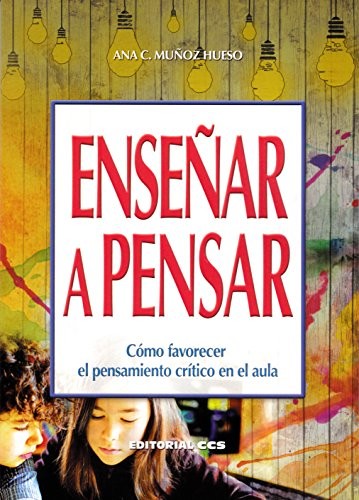 BookTeaching Critical Thinking — Ana Carmen Muñoz Hueso
A practical guide for teachers on how to integrate critical thinking into every subject. Strategies by educational level.
Debate CardsWebsiteCritical Thinking — Foundation for Critical ThinkingResources, minilessons, and critical thinking standards. The world's leading reference organization on this topic.
Dilemma CardsESWebsiteCritical Thinking in the Classroom — Educación 3.0Articles and resources in Spanish with concrete activities for developing critical thinking at different levels.
Bloom CardsESVideoTeaching Critical Thinking — TEDxTEDx talk on why and how to teach critical thinking in school.
Agreement ScaleOpinion ThermometerSilent DebateI Used to Think / Now I ThinkQuestion Dice