Frequently asked questions about Educational Hangman
How does Educational Hangman work?
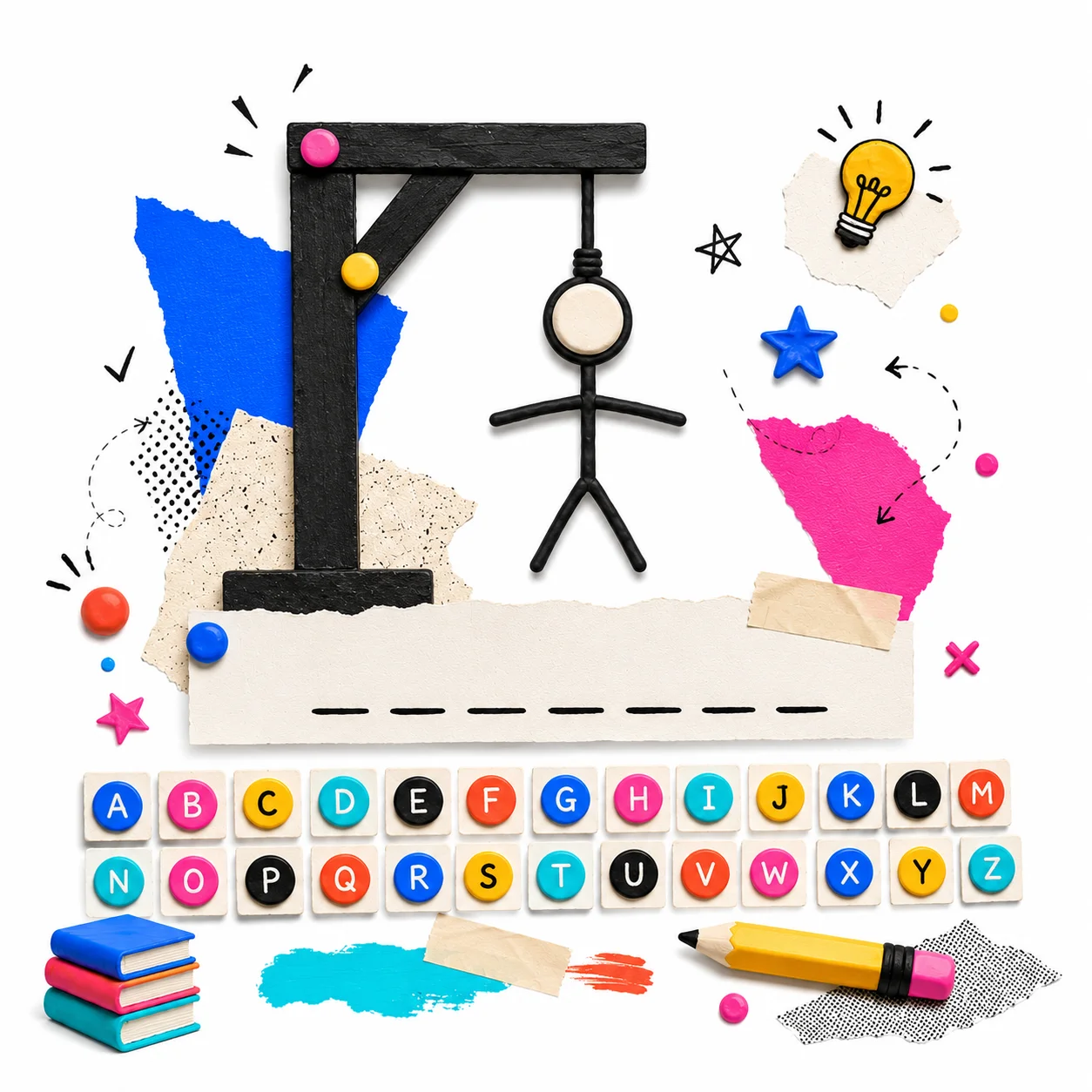
The game picks a secret word from the thematic bank you configured. You have to guess it letter by letter: if the letter is in the word, it appears in its position; if not, a part of the hangman is drawn. With 6 wrong guesses the drawing is complete and you lose. You can use the on-screen keyboard or the physical keyboard, and the game includes all letters.
Is Educational Hangman free? Do I need to sign up?
Yes, it is completely free. You do not need to create an account, sign up, or install anything. Open the link in any browser and start playing in seconds. It works on computer, tablet and smartphone, and is designed for projecting in class.
Can I use my own words?
Yes. In settings choose 'My words' and enter the words you want with an optional hint for each. Words are automatically converted to uppercase and can be any length. This lets you adapt the game to any vocabulary unit you are working on.
What thematic banks are included?
10 banks with 15 words each: Natural Sciences (photosynthesis, ecosystem, magnetism...), History and Geography (revolution, democracy, conquest...), Mathematics (triangle, equation, statistics...), Language and Literature (noun, metaphor, narrator...), Human Body (skeleton, neurons, pancreas...), Art and Music (perspective, melody, choreography...), Sports (athletics, basketball, fencing...), Technology (programming, algorithm, transistor...), Animals (metamorphosis, hibernation, camouflage...) and General Culture (philosophy, biodiversity, empathy...).
For which educational level is it appropriate?
It is very flexible. With the pre-designed banks it is ideal for upper elementary and all secondary levels. The vocabulary in each bank is designed to be challenging but achievable. Using custom words you can adjust it to any level and subject, from simple words for elementary school to technical terms for secondary or higher education.
How does the automatic hint work?
If you enable the 'Show hint on 3rd wrong guess' option in settings, on the third wrong guess the definition or description of the secret word appears below the board. This helps students who are moving more slowly to still have a chance of guessing without getting frustrated, and reinforces vocabulary learning in context.
Can it be played projected in class?
Yes, the design is built for that. The hangman drawing is large and visible, the word with blanks is shown in clearly readable letters, and the on-screen keyboard allows the teacher to operate the game or students to come up and choose letters. It is an ideal activity for reviewing vocabulary at the start or close of a unit.
What pedagogies support Educational Hangman?
Educational Hangman falls within Game-Based Learning and Purposeful Gamification: it uses a classic mechanic to work on specific vocabulary. It also aligns with Formative Assessment, since the teacher can observe which words the group knows, and with Microlearning, because each game is a short episode of focused vocabulary work.
What competencies does it develop?
Beyond vocabulary, the game works Logical reasoning (deducing the word from partial information), Metacognition (evaluating which letters are most probable), Frustration tolerance (managing mistakes without giving up) and Critical thinking (using the hint and revealed letters to make increasingly precise hypotheses).
Can it be used for review before an exam?
Yes, and it is one of its best applications. Load the key words of the unit to be assessed with a definition or important piece of information as the hint. The game makes review feel like entertainment: the group is focused, uses active memory to recall words, and when they fail, the hint reinforces the concept exactly at that moment. It is much more effective than rereading a summary.
How do you play hangman in class with the whole class?
Project the game on the screen or interactive whiteboard and play in full-class mode: students say letters aloud (or raise their hands) and the teacher enters them. You can also divide the group into teams where each one proposes a letter per turn, earning points for each correct one. With custom words you can create themed decks by unit and use it as a closing or warm-up activity.
Can it be used for English or other language classes?
Yes. In the 'My words' option you can load terms in English, Portuguese or any other language and add the translation or definition as the hint. It is ideal for foreign language vocabulary: the student has to remember how the word is spelled letter by letter, which reinforces spelling and orthographic memory much more than simply recognizing the word.
How long does a game last? Does it fit in a class period?
A game lasts between 2 and 5 minutes depending on the difficulty of the word and the group dynamics. It is ideal for the first or last 10 minutes of class: play 2 or 3 words, the group warms up or closes class with something concrete, and you finish in the right amount of time. After each word you can briefly discuss its meaning and move on to the next.
How is it different from Educational Wordle?
They are complementary games. In Educational Wordle you have to guess a fixed-length word in 6 complete attempts, using color information to refine each guess — it requires more strategy and deductive reasoning. In Hangman you guess letter by letter with no length limit: it is more intuitive, faster and more inclusive for different levels. Wordle works better for vocabulary of controlled length; Hangman handles longer, more complex terms like photosynthesis or independence.